
Are GMOs Bad for You?
What Three Decades of Science Actually Show

The topic of Genetically Modified Organism (GMO) foods is controversial, often emotionally charged and hotly debated in the wellness community. In this article we will strip all the opinions and emotional arguments and take an objective look at what the science actually tells us. At the end of this piece you will have all the objective information you need to make your own mind about the subject.

What is GMO Foods?
“GMO” is a label applied to a production method, not to a substance or an ingredient.
The category includes at least four distinct approaches. Transgenic modification inserts DNA from one species into another, the original and most contentious form. Cisgenic modification transfers genetic material between organisms of the same species, using molecular tools to accomplish what conventional cross-breeding does through repeated generations. Gene editing makes targeted changes to an organism’s existing DNA without inserting foreign material. Biofortification engineers crops to produce higher levels of nutrients they would otherwise contain in insufficient quantities.
It’s also worth noting that humanity has been deliberately manipulating plant genetics since agriculture began. Grafting was practiced in China and the Mediterranean more than two thousand years ago. The goal was always the same: combine desirable traits from different genetic sources into a single cultivated plant. What genetic engineering adds is molecular precision.
Why GMO Crops Exist
Yield improvement is frequently cited as the primary driver of GMO development, and it’s the easiest target for critics. The more complete picture is considerably more interesting.
Pest and disease resistance was among the earliest and most consequential applications. Crops engineered to produce Bacillus thuringiensis (Bt) toxins dramatically reduced crop loss to insect damage, and with it, the volume of broad-spectrum insecticides applied to food crops. A 2014 meta-analysis of 147 studies in PLOS ONE by Klümper and Qaim found that GMO crop adoption had on average reduced chemical pesticide use by 37% and increased yields by 22%, with farmer profits rising by 68%, gains concentrated in Bt crops and developing-world contexts with high pest pressure.
Insect damage creates entry points for fungal infection, and fungal infection produces mycotoxins, compounds with established carcinogenic and hepatotoxic properties. A meta-analysis of 21 years of field data by Pellegrino et al. in Scientific Reports (2018) found that Bt maize showed mycotoxin levels 28.8% lower, fumonisin levels 30.6% lower, and trichothecene levels 36.5% lower than conventional maize. If you are concerned about cancer risk from food, the evidence suggests Bt maize is the safer option.
Drought tolerance and post-harvest loss reduction address the agricultural realities of climate instability and food insecurity in lower-income countries. And then there is biofortification, specifically Golden Rice.
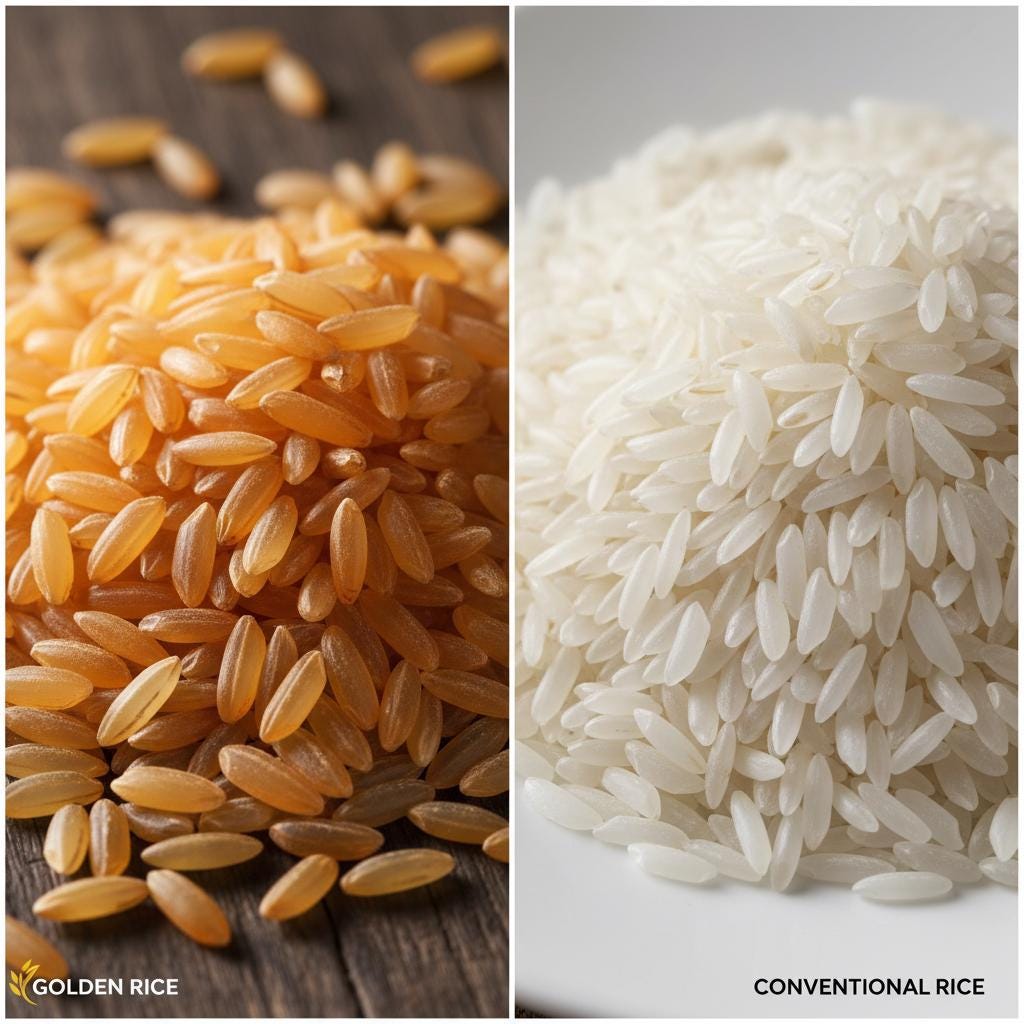
Golden Rice was engineered to produce beta-carotene, which the body converts to vitamin A, in a grain that hundreds of millions of people in South and Southeast Asia depend on as a dietary staple. Vitamin A deficiency is associated with an estimated 4,500 preventable child deaths daily and is the leading preventable cause of childhood blindness globally. A clinical trial by Tang et al. in the American Journal of Clinical Nutrition (2009) found that a single cup of Golden Rice can supply approximately 50% of the recommended daily intake of vitamin A. The bioavailability evidence is solid; the mortality extrapolation is reasonable but remains indirect.
Golden Rice has been actively opposed for decades by many of the same organizations that frame their advocacy as protecting human health. Some of that opposition reflects legitimate concerns about corporate control of food systems in vulnerable populations. But the scientific basis for opposing the crop itself is not there.
If you enjoy evidence-based medical information, subscribe to receive these articles delivered to your mailbox every week.
What the Health Evidence Actually Shows
Three decades of research encompassing more than 3,000 peer-reviewed studies and the formal consensus positions of every major independent scientific and public health body globally, find no consistent causal link between GMO food consumption and cancer, reproductive toxicity, allergic disease, or chronic illness.
The National Academies of Sciences (NAS) report, Genetically Engineered Crops: Experiences and Prospects (2016), is among the most comprehensive independent reviews ever conducted on a food technology question. A comprehensive review published in GM Crops & Food (2022) by Brookes and Barfoot, examining environmental and pesticide-related outcomes of GMO crop adoption from 1996 to 2020, similarly found no consistent evidence of harm to human health.
The European Union has been institutionally skeptical of GMO technology maintaining import restrictions and cultivation moratoriums that the scientific evidence has never justified. More than 130 independent research projects, involving over 500 research groups across more than 25 years and funded entirely by the European Commission, reached the same conclusion as every other major body: GMO crops are no more risky than those produced by conventional plant breeding. The European Commission published a summary of this program in 2010 as A Decade of EU-funded GMO Research, with subsequent EU Framework Programme funding extending the work.
The Study That Shaped a Generation of Fear
In 2012 a French molecular biologist named Gilles-Eric Séralini, published a paper in Food and Chemical Toxicology claiming that rats fed GMO maize developed tumors at dramatically elevated rates. The paper was accompanied by a coordinated media campaign, a book, a documentary, and graphic photographs of tumor-bearing animals. The political response was immediate: France’s prime minister called for a European ban, Russia suspended GMO maize imports, and Kenya banned GMO crop cultivation entirely. Then the science was examined.
The rat strain used, Sprague-Dawley, develops spontaneous tumors in up to 80% of animals by the end of a normal lifespan, making it a poor model for tumor causation studies. The sample sizes were inadequate for the statistical claims made. There was no dose-response relationship, a basic requirement for establishing biological causation. European Food Safety Authority (EFSA) issued a statement within weeks of publication declaring that the study did not meet acceptable scientific standards. The journal retracted the paper in November 2013, without the author’s consent, citing fundamental methodological failure. Séralini subsequently republished in a lower-tier journal; the republication addressed none of the substantive criticisms.
The pattern is not unique. Andrew Wakefield published a fraudulent case series in The Lancet in 1998 claiming a link between the measles-mumps-rubella (MMR) vaccine and autism. The paper was retracted; Wakefield was stripped of his medical license; the methodology was demonstrated to be fabricated. Measles outbreaks have continued in populations that absorbed the fear and never absorbed the correction.
The Concerns That Are Real
Herbicide-resistant weeds are a documented and growing problem. The International Survey of Herbicide Resistant Weeds has recorded 59 weed species that have developed resistance to glyphosate since 1996. Herbicide sales in Canada increased 270% between 1994 and 2023 following GMO crop introduction, according to the Canadian Biotechnology Action Network.
Biodiversity loss and soil microbiome disruption are associated with the agricultural practices that accompany large-scale GMO deployment. But here is the distinction the public conversation almost never makes: they are consequences of monoculture industrial agriculture misusing a powerful tool, not consequences of the tool itself.
The Irish potato famine of 1845 killed approximately one million people and drove another million into emigration; it resulted from the catastrophic vulnerability of a genetically uniform monoculture. One pathogen, Phytophthora infestans, swept through a crop with no genetic diversity to resist it. The vulnerability was created by industrial-scale cultivation of a single genetic variety, which is exactly what produces the ecological risks associated with GMO crops today. This problem predates GMO technology by a century.
Corporate consolidation of the seed market is a separate concern. Following the Bayer-Monsanto merger, Bayer controls an estimated 35% of the global corn seed market, 28% of soybean seed, and 70% of cottonseed, according to the National Sustainable Agriculture Coalition. USDA analysis has documented concerns about intellectual property concentration limiting farmer seed-saving rights. It is an economic and political question, however, not a food safety question.
Letting the Evidence Speak
You came to this piece with one question: are GMO foods bad for you?
The evidence now available to answer it spans 30 years, more than 3,000 peer-reviewed studies, and the independent scientific consensus of institutions on multiple continents, including institutions with every institutional incentive to find a problem if one existed.
The health fears are not supported by the evidence. Ecological concerns are real, but not arguments against genetic engineering itself. Corporate consolidation concern is legitimate, but is a market structure problem, not a health related concern.
And yet the most consequential applications of this technology are the ones that receive the least attention in a debate shaped almost entirely by the concerns of people who are not food insecure.
Now you have the evidence, but only you can answer the question: are GMO foods bad for you?
Found this article useful? Share your thoughts. Join the conversation below.
Educational content on The Metabolic Archives is free, because medical information should be accessible to everyone. If you find value and want to support the work, a paid subscription is available and genuinely appreciated. Visit the About Page for additional information.
The Metabolic Archives is for educational and informational purposes only, and is not intended as medical advice, diagnosis, or treatment, and does not constitute a doctor-patient relationship. Do not adopt any recommendation discussed in any article or guides published here, make changes or abandon any prescribed medical treatment without prior consultation with your physician. Always seek the advice of your physician or other qualified health provider for any questions regarding your medical condition and recommended treatment options.
By reading this post, you acknowledge that you have read and agree to the Terms of Service of The Metabolic Archives, which govern all use of this content including restrictions on reproduction.
© 2026 The Metabolic Archives. All rights reserved.