
Beyond the Nutrient Label
How You Eat Matters as Much as What You Eat


In Part 1, we looked at the 2025–2030 Dietary Guidelines and evaluated what they got right and what they got wrong on the specifics: ultra-processed food, protein targets, saturated fat, fiber, protein source hierarchy. The verdict was mixed.
While both the guidelines and their critics are entirely focused on food selection neither addresses how you eat. And the evidence increasingly suggests that the how is as metabolically consequential as the what.
The Nutrient-Counting Trap
The dominant framework in nutrition science and policy for the past half-century has been nutrient arithmetic. Measure the components of food. Set targets for each. Design a diet that hits the targets. It treats food as a collection of independent variables, each exerting its effect separately. The food they come from, the other foods consumed alongside them, the order in which they arrive, the pace at which the meal unfolds, none of these variables appear in the accounting.
Consider two meals with identical nutrient profiles, same protein, same carbohydrate, same fat, same fiber. One is eaten in twenty minutes, starting with bread, followed by meat, with vegetables as a side. The other unfolds over an hour, starting with a vegetable course dressed in olive oil, followed by a protein course, with starch arriving last in modest portions. While the nutrient arithmetic says these meals are equivalent, the metabolic response to them is not.
The Food Matrix, Why the Whole Outweighs the Parts
The metabolic effect of a food is determined by the totality of its composition and structure, what nutritional scientists call the food matrix, not by any single nutrient it contains. A piece of aged cheese is not the same metabolically as an equivalent quantity of processed cheese product, even if the macronutrient profiles look similar on a label.
The clearest everyday illustration of this principle is the difference between an actual potato and instant boxed mashed potatoes. Both are derived from the same plant. Both are labeled as potato on a nutrition panel. The actual potato retains its cellular structure, that structure slows digestion, moderates glucose release, and engages satiety signaling differently than a product in which the cellular architecture has been industrially destroyed and then reconstituted with additives.
Food Sequencing, The Evidence the Guidelines Ignored
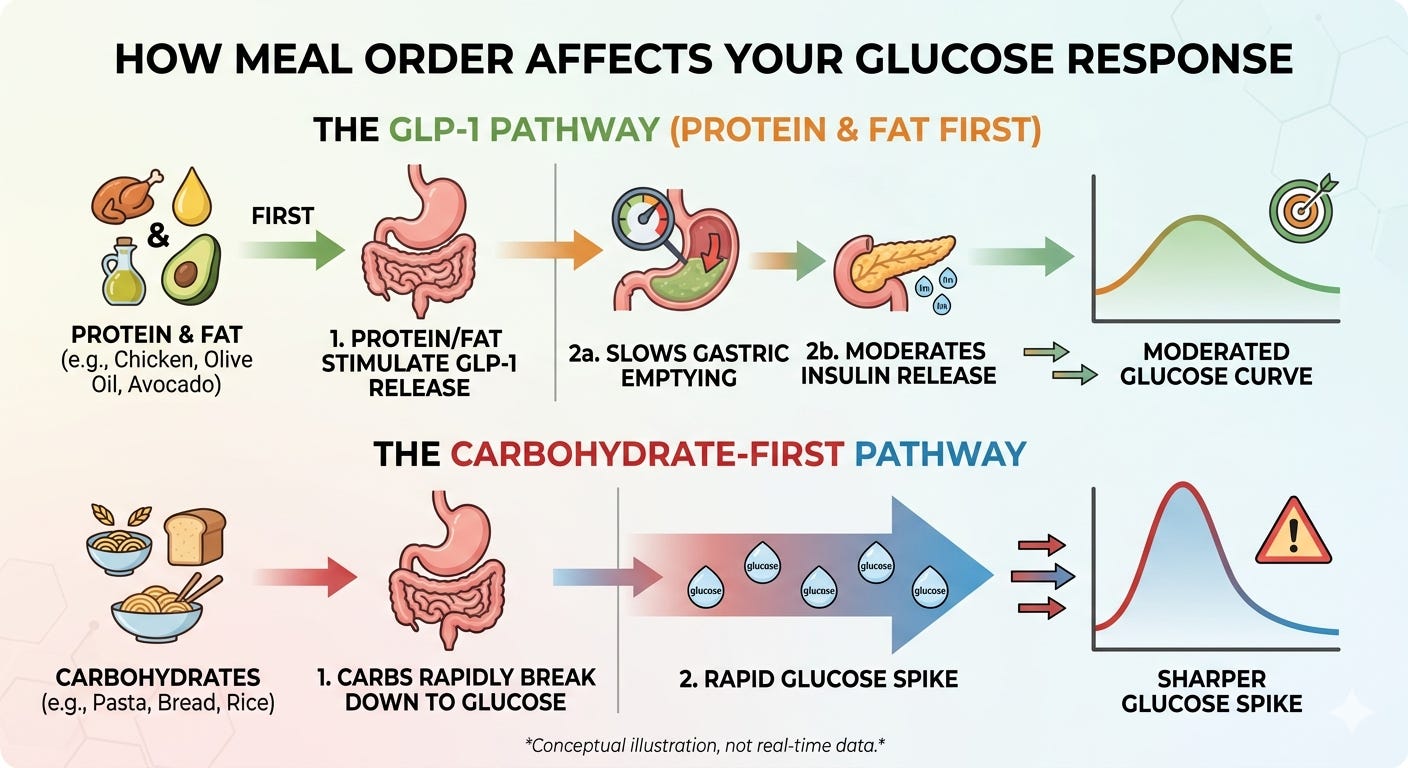
A landmark crossover study conducted at Weill Cornell Medicine and published in Diabetes Care in 2015 tested what happened when overweight and obese adults with type 2 diabetes ate the same meal in different orders. When protein and vegetables were consumed before carbohydrates, the postmeal blood glucose area under the curve was 73% lower compared to the carbohydrate-first condition. Postprandial insulin was also significantly reduced.
A subsequent crossover study in adults with pre-diabetes extended the finding: post-prandial glucose peaks were attenuated by about 40% in both the protein-and-vegetables-first and vegetables-first meal compared to carbohydrate-first. The glucose area under the curve was 38.8% lower over 180 minutes when protein and vegetables led the meal.
If you enjoy evidence-based medical information, subscribe to receive these articles delivered to your mailbox every week.
More recently a 2025 study in Diabetes Care using continuous glucose monitoring in type 2 diabetes demonstrated that carbohydrate-last food order improved time-in-range and reduced glycemic variability. It was not just acutely but over a sustained monitoring period, correlating laboratory findings with real-world conditions.
The sample sizes are modest and the food sequencing literature is still developing. But two things give the findings credibility beyond their sample sizes: the consistency of effect across independent studies in different populations, and the mechanism.
When protein and fat arrive in the gut before carbohydrate, they stimulate the release of glucagon-like peptide-1 (GLP-1) from intestinal cells. GLP-1 slows gastric emptying, suppresses glucagon, and amplifies insulin secretion in anticipation of the carbohydrate load that follows. The result is a more gradual glucose absorption with lower insulin peaks. This is the same physiological pathway that GLP-1 receptor agonist medications exploit pharmacologically. Food sequencing activates it for free through the order in which you choose to eat.
A 16-week behavioral pilot study published in MDPI Nutrients in 2023 found that 94% of participants reported high adherence to carbohydrate-last food order, and 72% reported it was easy to implement. It also naturally improved overall diet quality by increasing protein and vegetable consumption at the start of meals.
Protein Distribution, Not Just How Much, But When
Total daily protein intake is not the only variable that determines whether that protein supports muscle preservation. Adequate protein consumption at each individual meal, particularly breakfast, is equally important. Muscle protein synthesis requires a sufficient leucine threshold to be triggered at each meal. Consuming 100 grams of protein in two large meals while eating little protein at breakfast does not produce the same muscle-preserving effect as distributing that intake more evenly.
A 2015 review in Nutrients by Nowson and O’Connell found that many older adults consume inadequate protein particularly at breakfast, with frail populations falling below the threshold required to stimulate muscle protein synthesis at both breakfast and lunch. The practical implication is direct: if you are targeting 1.2 g/kg daily for muscle preservation, the distribution of that intake across your meals matters and breakfast is where the gap is most likely to be.
Breakfast is considered the most important meal of the day for protein utilization. Studies in both mice and humans (notably a 2025 follow-up on “Chrononutrition”) indicate that the body’s machinery for Muscle Protein Synthesis (MPS) is more sensitive and active in the morning. This results suggest prioritizing protein intake at breakfast time may favor muscle mass preservation and expansion.
What Traditional Meal Cultures Understood Without Knowing Why
I grew up in Spain in the 1960s and 70s when the multi-course meal structure was an ordinary feature of daily life. These large meals were eaten with family and close friends over more than an hour, where social interaction was the dominant aspect.
The sequence was consistent: a light soup and/or a simple salad lightly dressed with olive oil and vinegar, came first. A vegetable or legume course followed. Meat came third. Starch, mostly rice, or potatoes, arrived last. Dessert came in small portions after satiety was already well established.
This meal architecture evolved through centuries of cultural practice, shaped by what worked. The lived experience was simple: by the time the starch course arrived, fullness was sufficient to naturally limit consumption. While dessert portions were small, often could not be finished. The structure of the meal did the work.
This is the beginning of a larger conversation. How different food cultures have instinctively organized eating in ways that solve metabolic problems, a subject we will return to in future articles.
Action Steps: Building Meal Architecture Into Your Daily Life
1. Sequence your meals deliberately. At every meal where sequencing is possible, lead with protein and non-starchy vegetables. Eat your starch last. You do not need to eliminate carbohydrates just change when they arrive.
2. Protect breakfast protein. If you are consuming higher protein intake for muscle preservation, breakfast is the most important meal to target. A breakfast built around quality protein sources activate muscle protein synthesis.
3. Slow the pace of eating. Satiety signaling has a lag, it takes approximately 15–20 minutes for the hormonal signals initiated by eating to reach the brain and register as fullness. A meal eaten in ten minutes bypasses that signaling almost entirely. Slowing down allows the satiety signals to fully establish as intended.
4. Read the ingredient list, not just the label. If the list is long, unfamiliar, and reads like a chemistry catalogue, the matrix has been industrially disrupted. To learn more check my food label article here.
5. Treat eating as a system, not a set of rules. The nutrient-counting framework gives you rules to follow. Understanding why the sequence, the food matrix, and eating pace matters, provides you with an architecture to easily apply on every meal.
Found this article useful? Share your thoughts. Join the conversation below.
Educational content on The Metabolic Archives is free, because medical information should be accessible to everyone. If you find value and want to support the work, a paid subscription is available and genuinely appreciated. Visit the About Page for additional information.
Disclaimer: The information provided in The Metabolic Archives is for educational and informational purposes only, and is not intended as medical advice, diagnosis, or treatment, and does not constitute a doctor-patient relationship. Do not adopt any recommendation discussed in any article or guides published here, make changes or abandon any prescribed medical treatment without prior consultation with your physician. Always seek the advice of your physician or other qualified health provider for any questions regarding your medical condition and recommended treatment options.
By reading this post, you acknowledge that you have read and agree to the Terms of Service of The Metabolic Archives, which govern all use of this content including restrictions on reproduction.
© 2026 The Metabolic Archives. All rights reserved.