
Coenzyme Q10- A Supplement Worth a Closer Look
A widely used supplement with genuine biochemical importance

CoQ10 is real, the biochemistry is established and not in dispute, the compound has a regulatory history as a prescription drug in Japan, decades of physician-driven recommendations across multiple specialties, and a safety profile better than almost any other supplement on the market. What this piece examines is the gap between what the biochemistry establishes and what the clinical evidence actually supports; that gap is wider than most patients, and many physicians, recognize.
What CoQ10 Is and Where It Came From
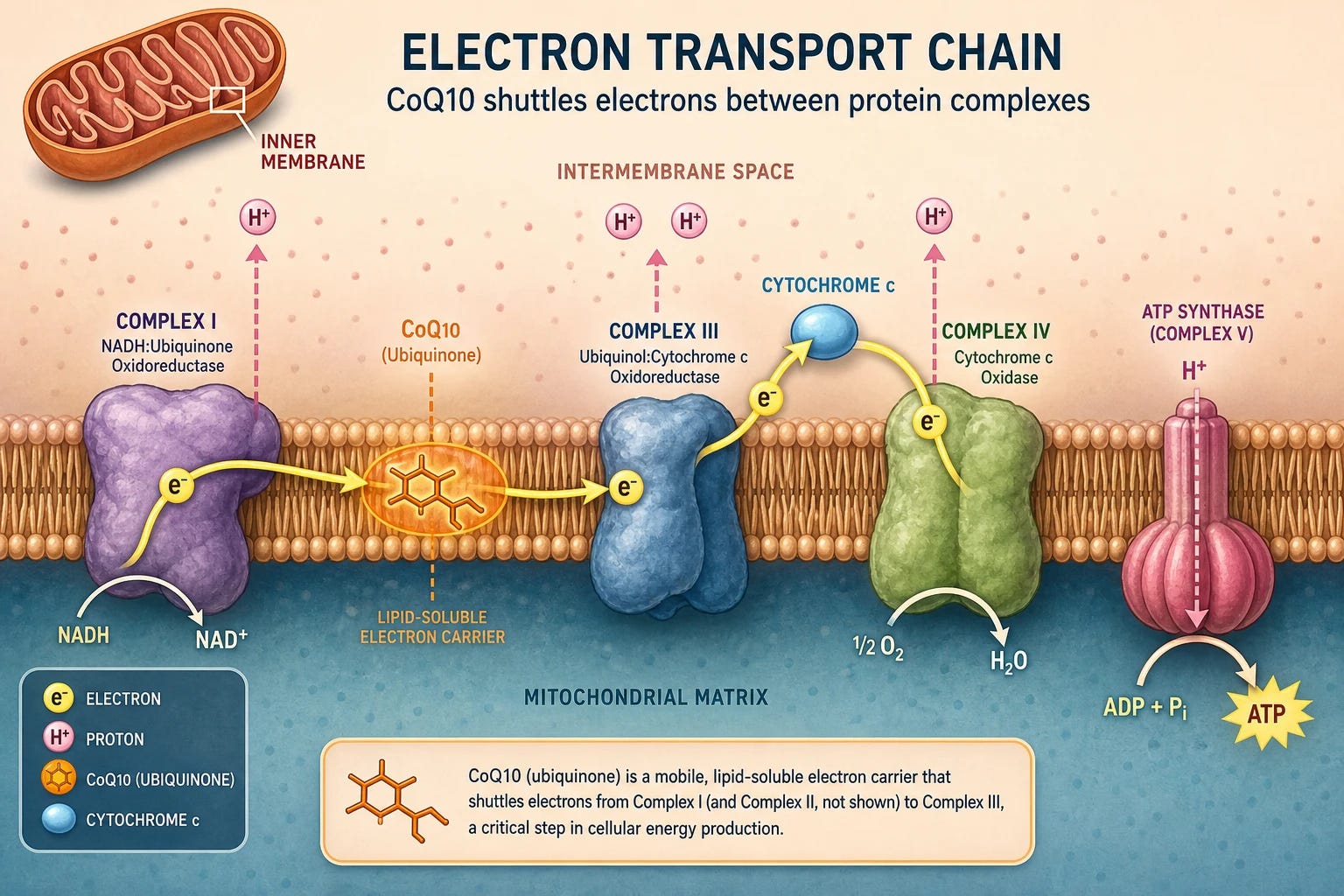
CoQ10 was isolated in 1957 by Frederick Crane at the University of Wisconsin, extracted from beef heart mitochondria (Crane et al., Biochim Biophys Acta, 1957). Karl Folkers at Merck worked out the chemical structure the following year. Peter Mitchell’s chemiosmotic theory, which earned him the Nobel Prize in 1978, clarified what CoQ10 actually does: it is the mobile electron carrier that shuttles electrons between Complexes I and II and Complex III in the mitochondrial respiratory chain. Every cell that produces adenosine triphosphate (ATP) through oxidative phosphorylation depends on it. CoQ10 also serves a second role as a lipid-soluble antioxidant in cell membranes and lipoproteins.
Your body makes CoQ10: the synthesis starts from the amino acid tyrosine and runs through a long biochemical pathway. The early steps of that pathway are shared with cholesterol synthesis, specifically the mevalonate pathway. This shared origin is the entire biochemical basis of the statin-CoQ10 narrative that comes later. Tissue levels of CoQ10 decline with age in some tissues but not others, and the clinical significance of that decline is far less established than supplement marketing suggests.
Dietary intake in a typical Western diet adds 3 to 6 milligrams per day on average (López-Lluch et al., Antioxidants, 2019). The richest sources are organ meats (beef heart, liver, and kidney at roughly 3 to 12 milligrams per 100 grams), fatty fish (sardines, mackerel, salmon at 2 to 6 milligrams per 100 grams), other meats, nuts, seeds, and some vegetable oils. Healthy adults with adequate nutrition meet their physiologic needs through endogenous synthesis plus diet.
The Japanese Regulatory History
In 1974, Japan approved CoQ10 as a prescription drug for congestive heart failure. This is unusual in the supplement landscape and partly explains why CoQ10 carries more medical credibility than other dietary supplements. Most physicians who recommend it are responding, at least in part, to that regulatory pedigree and to the early enthusiasm it generated in the cardiology literature of the 1980s and 1990s. Worth knowing as you weigh the recommendations you have received.
Ubiquinol Versus Ubiquinone
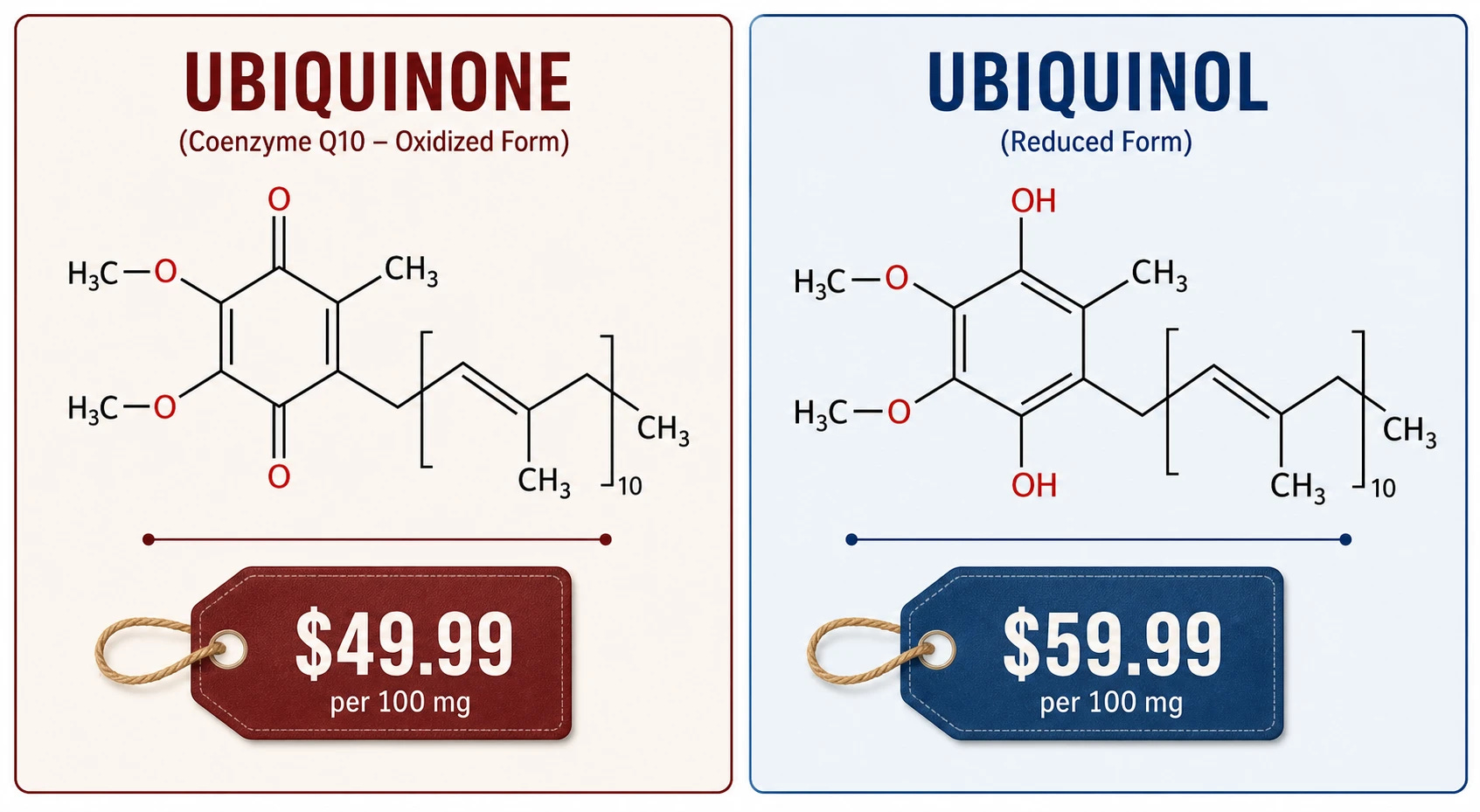
Two oxidation states of CoQ10 are sold commercially: ubiquinone (the oxidized form) and ubiquinol (the reduced form). The supplement industry has built a substantial premium on the claim that ubiquinol is 2 to 3 times more bioavailable and the only worthwhile form to take. The independent evidence does not support this unequivocally.
Some studies show modestly higher plasma levels with ubiquinol (Langsjoen and Langsjoen, Clin Pharmacol Drug Dev, 2014, though that author has commercial ties to ubiquinol products). Other studies show no meaningful difference when the carrier oil is matched between formulations. The independent reviews converge on a different conclusion: what drives bioavailability is the formulation itself, specifically oil-based softgels with appropriate lipid carriers, more than the redox state of the molecule (López-Lluch et al., Nutrition, 2019).
The single largest positive clinical trial in CoQ10’s entire history, the Q-SYMBIO trial in heart failure, used ubiquinone, not ubiquinol. No head-to-head clinical outcome trial has shown ubiquinol superiority on any meaningful endpoint. The premium price for ubiquinol products is not supported by outcome data.
The Statin Question
Statins work by inhibiting hydroxymethylglutaryl-coenzyme A reductase (HMG-CoA reductase), which reduces flux through the mevalonate pathway, which in turn reduces endogenous CoQ10 synthesis. Plasma CoQ10 levels fall measurably during statin therapy. From this established biochemistry, the leap was made that statin-related muscle symptoms are caused by CoQ10 depletion, and that supplementation can prevent or treat them. However the trial evidence is genuinely mixed.
Multiple meta-analyses of small open-label trials have reported symptomatic benefit. The 2018 meta-analysis by Qu and colleagues pooled 12 randomized controlled trials (RCTs) with 575 patients and reported reductions in muscle pain, weakness, cramps, and tiredness (Qu et al., J Am Heart Assoc, 2018). The same analysis found no reduction in creatine kinase (CK), the blood marker of muscle injury. Whatever symptomatic improvement was being reported was not reflecting reduced muscle damage.
Kennedy and colleagues, working from a similar trial base in 2020, came to the opposite conclusion: no significant benefit on statin-associated muscle symptoms (Kennedy et al., Atherosclerosis, 2020). A 2025 meta-analysis from Kovacic and colleagues in the Journal of Nutritional Science found the picture more nuanced still (Kovacic et al., J Nutr Sci, 2025). When the authors separated trials that enrolled patients with confirmed statin-associated muscle symptoms from trials that did not, the trials with confirmed symptoms showed no significant pain reduction, while trials without that inclusion criterion did. Translation: when you select patients whose muscle symptoms are actually verified as statin-related, CoQ10 fails to help.
The decisive trial in this space is Taylor and colleagues’ 2015 study in Atherosclerosis. The investigators first used a blinded crossover design to confirm whether patients who reported statin myalgia actually had reproducible symptoms when rechallenged with statin versus placebo. Only 36 percent of patients with reported statin myalgia had reproducible symptoms on blinded crossover. In that subset, the patients with confirmed, verified statin-induced muscle pain, CoQ10 produced no benefit on pain, strength, or exercise performance (Taylor et al., Atherosclerosis, 2015).
Now consider this: in Taylor’s study, if only 36 percent of reported statin myalgia is real, what is the other 64 percent?
The SAMSON trial (Howard et al., J Am Coll Cardiol, 2021) used an elegant crossover design, alternating statin, placebo, and no-treatment months in the same patients. The result: 90 percent of the symptom burden patients attributed to statins was reproduced by placebo. The StatinWISE trial (Herrett et al., BMJ, 2021) reached the same conclusion: no difference in muscle symptoms between statin and placebo periods. The Cholesterol Treatment Trialists’ Collaboration meta-analysis (Lancet, 2022) pooled blinded RCT data from approximately 120,000 patients and found that the true excess of muscle pain on statins, over what occurs on placebo, is less than 1 percentage point in the first year of therapy, with no excess after the first year. Confirmed, clinically significant statin myopathy (the rare condition with elevated CK and genuine muscle injury) occurs in well under 0.1 percent of statin users per year.
Across my forty years of medical practice, the great majority of patients started on statins tolerated them without muscle complaints. Of the patients who did complain of muscle pain, most had normal CK and the symptoms typically resolved over time. The patients who were actually taken off statins for muscle injury, the ones with elevated CK and muscle tenderness on examination, were a small handful across four decades. This pattern is exactly what the blinded RCT evidence predicts and is fundamentally incompatible with the supplement industry’s framing of statin myalgia as a widespread epidemic requiring routine CoQ10 supplementation.
The premise that 20 percent or more of statin users have CoQ10-depletion-driven muscle injury is itself overstated. Most reported statin intolerance is a nocebo response, the appearance of symptoms when a patient expects them, not an actual pharmacologic injury. When open-label CoQ10 trials enroll such patients, any plausible-sounding intervention will appear to work. When blinded trials enroll patients with confirmed, reproducible muscle symptoms, CoQ10 does not help and does not reduce CK.
The evidence of CoQ10 efficacy is mixed; the practice of routinely pairing CoQ10 with every statin prescription is not as well-supported as commonly believed. A patient with new muscle symptoms on a statin is better served by first confirming whether those symptoms are actually statin-related, ideally by withdrawal and rechallenge, since the nocebo response rate is high. For a patient with confirmed, persistent statin-related muscle symptoms, a trial of CoQ10 is a defensible thing to consider given the supplement’s excellent safety profile.
The physicians who recommended CoQ10 to statin patients, including cardiologists, generally did so in good faith. The early cardiology literature was enthusiastic, mechanism-based reasoning was compelling, and small positive trials were available. The Japanese regulatory pedigree alone carried significant weight. A recommendation pattern formed in the 1990s and 2000s, and was passed to patients with the full weight of medical authority.
If you enjoy evidence-based medical information, subscribe to receive these articles delivered to your mailbox every week.
Heart Failure
The Q-SYMBIO trial (Mortensen et al., JACC Heart Fail, 2014) randomized 420 patients with New York Heart Association (NYHA) Class III and IV heart failure to CoQ10 300 milligrams per day versus placebo on top of standard therapy. At two years, the active arm had reduced major adverse cardiovascular events (15 percent versus 26 percent in the placebo arm) and reduced cardiovascular mortality. This is the strongest single piece of CoQ10 evidence in any indication.
The trial had short-term endpoint failures at 16 weeks: no improvement in NYHA functional class, no improvement in 6-minute walk distance, no reduction in N-terminal pro-brain natriuretic peptide (NT-proBNP). There was significant regional outcome heterogeneity, with the benefit substantially larger at non-European sites.
The trial has never been replicated. Background heart failure therapy has advanced dramatically since 2014, with sodium-glucose cotransporter-2 (SGLT2) inhibitors, sacubitril/valsartan, and optimized mineralocorticoid receptor antagonist (MRA) use all becoming standard. No trial has tested CoQ10 on top of contemporary guideline-directed medical therapy. Neither the American Heart Association/American College of Cardiology nor the European Society of Cardiology heart failure guidelines recommend CoQ10.
The KiSel-10 trial (Alehagen et al., Int J Cardiol, 2013) randomized 443 elderly Swedes aged 70 to 88 to a combination of selenium 200 micrograms plus CoQ10 200 milligrams daily versus placebo for 4 years. Cardiovascular mortality was 5.9 percent in the active arm versus 12.6 percent in placebo at 5 years. The mortality difference persisted at 12-year follow-up, the longest-duration positive finding in the CoQ10 literature.
This was a combination intervention in a known selenium-deficient population. Sweden has low soil selenium and consequently low population selenium status. The trial cannot determine whether the benefit came from CoQ10, from selenium, or from the combination, and the results cannot be generalized to populations with adequate selenium intake.
Primary CoQ10 Deficiency
Primary CoQ10 deficiency syndromes are rare genetic disorders caused by mutations in CoQ10 biosynthetic genes, these patients cannot make adequate CoQ10. If supplementation were going to work robustly in any indication, this would be the one.
The 2022 systematic review by Wang and Hekimi (J Cell Mol Med) examined 89 cases of primary CoQ10 deficiency. Only 27 percent of patients with confirmed primary CoQ10 deficiency showed clinical improvement on supplementation. Even in the disease where supplementation has the strongest possible justification (the body genuinely cannot make enough CoQ10), the clinical response rate is below one in three.
This is the most sobering single data point in the literature, because it sheds real doubt on the broader industry premise that supplementation reliably corrects presumed CoQ10 “deficiency” in any population.
Migraine Prophylaxis
The American Academy of Neurology and American Headache Society guidelines give CoQ10 a Level C recommendation (”possibly effective”) for migraine prevention, placed alongside magnesium and feverfew. Two small RCTs (Sándor et al., Neurology, 2005; Dahri et al., Nutr Neurosci, 2019) showed reduced attack frequency. The 2021 meta-analysis by Sazali and colleagues (BMJ Open) pooled 6 RCTs with 371 patients and found reduced attack frequency and duration but not severity. A pediatric crossover trial was negative (Slater et al., Cephalalgia, 2011).
The evidence base is small and modest in quality but reasonably consistent in adults. The biological premise (mitochondrial dysfunction contributing to migraine pathophysiology) has independent support from neurologic research. For an adult with episodic migraine who is not getting adequate prophylaxis from first-line options, or cannot tolerate them, a trial of CoQ10 is a reasonable alternative.
Claims That Are Weaker, Equivocal, or Refuted
Hypertension
The 2007 meta-analysis by Rosenfeldt and colleagues claimed blood pressure reductions of 16 millimeters of mercury (mmHg) systolic and 8 mmHg diastolic. This figure, inflated by the inclusion of open-label trials, is still cited in supplement marketing nearly two decades later.
The 2016 Cochrane review by Ho and colleagues, restricted to RCTs only, found no significant effect on blood pressure. The most recent and largest pooled analysis (Karimi et al., Int J Cardiol Cardiovasc Risk Prev, 2025) included 45 RCTs and reported a 3.44 mmHg reduction in systolic blood pressure with no significant effect on diastolic pressure. Worth noting that the 2025 analysis detected significant publication bias by Egger’s test and showed very high statistical heterogeneity, both of which the authors acknowledge should temper interpretation.
Parkinson’s Disease
The QE3 trial (Beal et al., JAMA Neurol, 2014) randomized 600 patients with early Parkinson’s disease to CoQ10 1200 milligrams per day, 2400 milligrams per day, or placebo. The trial was terminated early for futility. Both active arms trended slightly worse than placebo on the primary endpoint. The earlier German trial by Storch and colleagues (Arch Neurol, 2007) was also negative. QE3 is the largest and best-designed CoQ10 trial in any neurodegenerative disease. The earlier Phase II suggestion of benefit was definitively refuted. Anyone still recommending CoQ10 for Parkinson’s disease is not engaging the current evidence.
Male Infertility
Multiple meta-analyses report that CoQ10 supplementation improves sperm concentration, motility, and morphology in men with idiopathic infertility. The 2013 meta-analysis by Lafuente and colleagues (J Assist Reprod Genet) found improved sperm surrogate markers but no evidence of increased pregnancy rates and no live birth data. A 2025 meta-analysis (Bakri et al., World J Mens Health) pooled 9 trials with 781 participants and claimed a clinical pregnancy rate benefit, but the included trials are small, heterogeneous, and largely unblinded, and live birth was not reported.
This is a textbook surrogate-versus-hard-endpoint disconnect: the numbers on the semen analysis improve, but whether that reliably translates to actual births remains unproven.
“Energy,” Anti-Aging, Cognition, Skin, Longevity
There is no meaningful clinical evidence in healthy adults for these claims.
The reasoning offered (”CoQ10 is in mitochondria, mitochondria make energy, therefore CoQ10 boosts energy”) is biologically illiterate as applied. These claims represent marketing extrapolation from biochemistry to clinical benefit with no controlled trial support.
Cancer Prevention or Treatment
Despite a long history of claims and early case series, modern controlled trials have not supported any role.
Safety
CoQ10 has an excellent safety profile across the entire dosing range studied in trials, from 60 to 3600 milligrams per day. The most common adverse effects are mild gastrointestinal symptoms (nausea, epigastric discomfort, diarrhea) at less than 1 percent incidence, with no clear dose-response relationship. Occasional reports of headache, insomnia (which is worse with evening dosing), and rare rashes round out the adverse event profile. Hathcock and Shao’s 2006 risk assessment derived an observed safe level of 1200 milligrams per day (Regul Toxicol Pharmacol). The 2008 Japanese safety assessment by Hidaka and colleagues derived an acceptable daily intake of 12 milligrams per kilogram per day (Biofactors). For an average 70-kilogram adult, that corresponds to about 840 milligrams per day with a wide safety margin.
Drug Interactions
The structural similarity between CoQ10 and vitamin K provides biological plausibility for a reduction in international normalized ratio (INR). Several case reports document INR decreases requiring warfarin dose adjustment after starting CoQ10. One small RCT in stable warfarin patients found no significant effect (Engelsen et al., Thromb Haemost, 2003, n=24). The interaction is real but probably uncommon and modest in magnitude. Patients on warfarin who start or stop CoQ10 should consult with their physician for additional surveillance.
There is no documented clinically significant interaction with the direct oral anticoagulants (DOACs): apixaban, rivaroxaban, edoxaban, or dabigatran.
What to Take Away
CoQ10 is biochemically real, physiologically essential, and produced by your body in adequate amounts under normal circumstances. The supplement’s safety profile is favorable, for patients who choose to take it the downside risk is low.
If you are currently taking CoQ10 because a physician recommended it when you were started on a statin, you now have the information to discuss the recommendation. A thoughtful conversation with your physician, armed with this information, is more useful than continuing supplementation on autopilot.
If you are considering CoQ10 for one of the better-supported indications (advanced heart failure, migraine prophylaxis), you can weigh the evidence as it actually stands rather than as it is marketed. If you are considering it for “energy,” anti-aging, cognition, or general wellness, the evidence does not support the expectation that you will get what you are paying for.
Found this article useful? Share your thoughts. Join the conversation below.
Educational content on The Metabolic Archives is free, because medical information should be accessible to everyone. If you find value and want to support the work, a paid subscription is available and genuinely appreciated. Visit the About Page for additional information.
The Metabolic Archives is for educational and informational purposes only, and is not intended as medical advice, diagnosis, or treatment, and does not constitute a doctor-patient relationship. Do not adopt any recommendation discussed in any article or guides published here, make changes or abandon any prescribed medical treatment without prior consultation with your physician. Always seek the advice of your physician or other qualified health provider for any questions regarding your medical condition and recommended treatment options.
By reading this post, you acknowledge that you have read and agree to the Terms of Service of The Metabolic Archives, which govern all use of this content including restrictions on reproduction.
© 2026 The Metabolic Archives. All rights reserved.