
How the Industry Wants to Rename What’s in Your Food
The Lobbying Push That Could Make Ultra-Processed Food Harder to Identify

OPINION PIECE
On July 24, 2026, Reuters reported that Nestle has been lobbying U.S. regulators, including officials in Health and Human Services Secretary Robert F. Kennedy Jr.’s team, to allow “common names” instead of technical names on ingredient labels (originally reported by Reuters, reporting by Richa Naidu; accessible reprint available at BNN Bloomberg). This lobbying effort had not been previously reported before the Reuters exclusive.
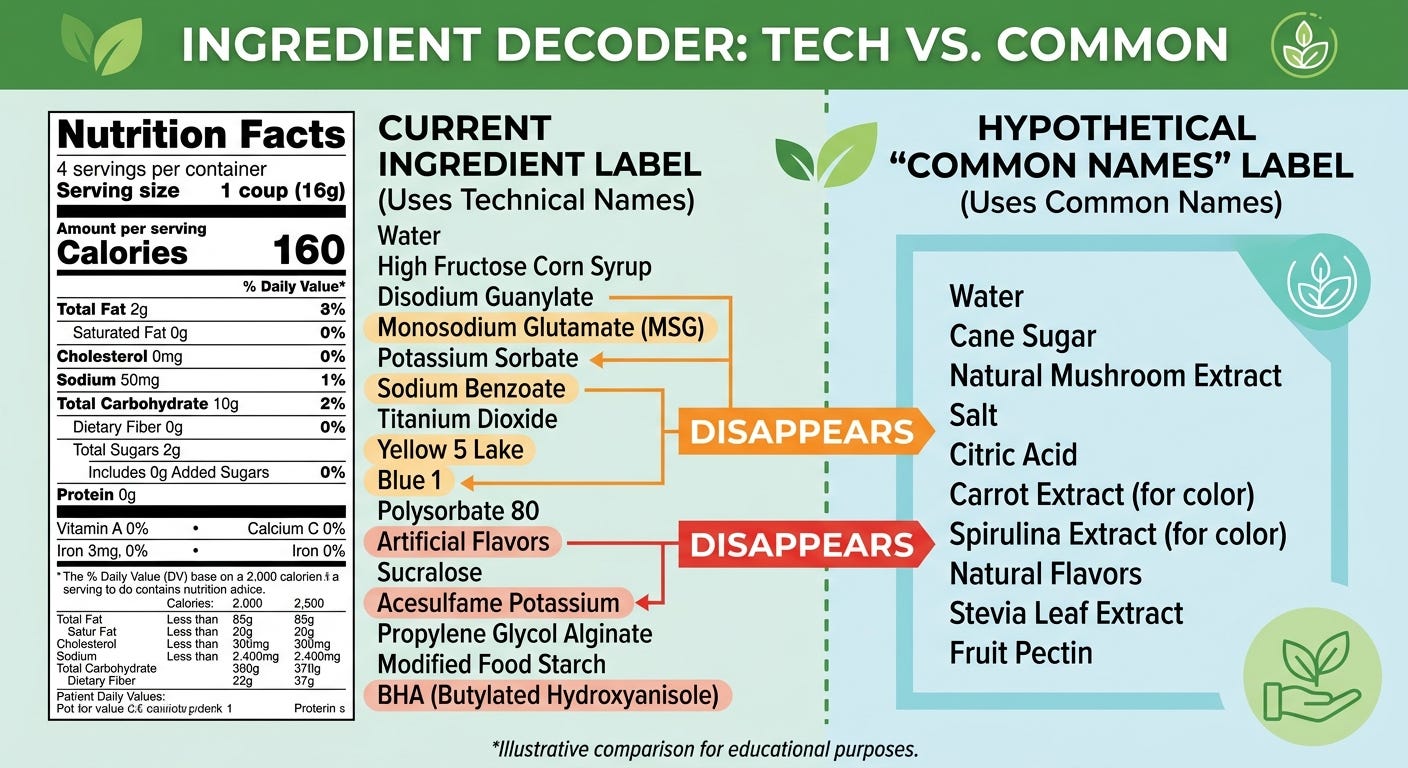
The examples Nestle leads with sound reasonable. Replace “ascorbic acid” with “vitamin C.” Replace “beta-carotene” with “vitamin A.” A former senior Nestle executive told Reuters the current system makes products sound like “Frankenstein food” when the ingredients are actually natural and have common-language equivalents. Nestle’s technology chief, Stefan Palzer, confirmed the company is engaged in lobbying via trade associations to make labels less complex.
The Coalition Behind It
Nestle is not acting alone. The company is part of Americans for Ingredient Transparency (AFIT), a 501(c)(4) nonprofit launched in October 2025. AFIT’s membership includes Nestle, Coca-Cola, PepsiCo, Kraft Heinz, General Mills, Tyson Foods, Cargill, and more than a dozen food industry trade associations.
The coalition is also pushing for federal legislation that would preempt state-level ingredient laws, creating a single national standard that would override stricter protections individual states have already enacted. Consumer advocacy groups, including Consumer Reports and the Environmental Working Group, have criticized AFIT as an industry effort to block more protective state food safety laws under the banner of “transparency.”
According to a June 2026 investigation by NOTUS, organizations lobbying specifically on reform of the Generally Recognized as Safe (GRAS) process nearly tripled from 12 in the first quarter of 2025 to 35 in the first quarter of 2026. AFIT alone spent $240,000 on lobbying between August 2025 and March 2026. Four companies that publicly committed to removing artificial food dyes, Nestle, PepsiCo, Coca-Cola, and Keurig Dr Pepper, met individually with Food and Drug Administration (FDA) officials to lobby on GRAS reforms, according to meeting records reported by NOTUS. Around the same time, the FDA quietly updated its website to extend the compliance deadline for the industry’s voluntary dye removal commitment by a full year, from the end of 2026 to the end of 2027.
Several of the same companies publicly pledging to remove ingredients from their products are simultaneously lobbying to rename the ingredients they intend to keep. Nestle itself pledged in early 2015 to remove artificial flavors and colors from its products by the end of that year. As the Associated Press reported in June 2025, that promise did not hold. As of mid-2025, Nestle said roughly 90% of its U.S. portfolio no longer contained synthetic dyes and made a new pledge for elimination by mid-2026. That second promise was eventually fulfilled.
The Data They Cite and the One They Don’t
Nestle’s proposal leans on a report by Innova Market Insights (an industry aligned market research company) finding that about 75% of North American consumers reconsider purchases because of ingredient lists. The industry reads this as evidence that technical names are scaring consumers away from safe products.
The same research organization during the same period, published findings that tell a different story. In a July 2025 press release ahead of the Institute of Food Technologists (IFT) first conference in Chicago, Innova reported that only 36% of North American consumers describe their approach to healthy eating as actively limiting ingredients they consider harmful. Lu Ann Williams, Innova’s Global Insights Director, stated that affordability and enjoyment remain the dominant drivers of food choice, while “demonized ingredients are not a major concern for most consumers.”
The 75% number most likely reflects a general unease at encountering unfamiliar terms on a label, not a sophisticated ingredient-by-ingredient evaluation. The industry’s response to that unease is to make the terms less unfamiliar. The consumer-protective response would be to help people understand what those terms actually mean.
The EU Comparison They Cherry-Picked
The Reuters article frames European labeling as more flexible and consumer-friendly, noting that in Europe, ascorbic acid can appear on labels as “vitamin C.” That is true.
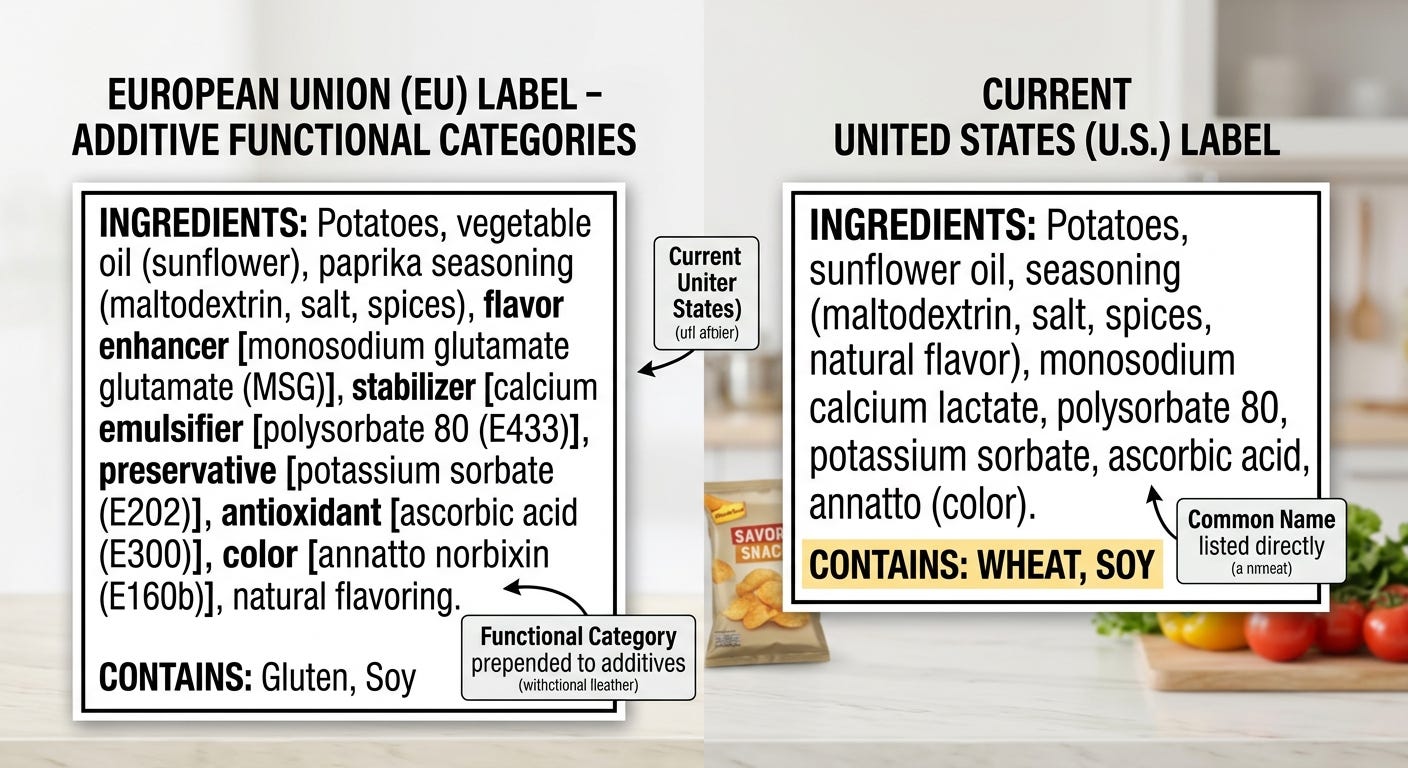
But the article omits that under EU Regulation (EC) No 1333/2008 on food additives, every food additive that appears on an ingredient list must be preceded by the name of its functional category: antioxidant, emulsifier, preservative, stabilizer, and so on. A European label does not just say “vitamin C.” It says “antioxidant: vitamin C” or “antioxidant: ascorbic acid” or “antioxidant: E300.” The consumer sees both what the ingredient is and why it is there.
Nestle is citing the part of the EU system that makes labels look simpler while ignoring the functional-category disclosure that makes the EU system more transparent, not less. If the U.S. adopted the full EU approach, consumers would actually get more information than they have now.
If you enjoy evidence-based medical information, subscribe to receive these articles delivered to your mailbox every week.
The Identifying Markers of Ultra-Processed Food
The technical names on ingredient lists are not obstacles to understanding. They are the tools that allow you to identify ultra-processed food (UPF).
The NOVA classification system, increasingly the global standard for categorizing food by degree of processing, identifies UPF (Group 4) by the presence of specific marker ingredients. A 2023 study published in Public Health Nutrition by Neumann, Eichner, and Fasshauer analyzed 2,146 commercial products from the UK market and found that just three categories of markers (flavourings, emulsifiers, and colourants) detected about four out of five UPF products. When the researchers expanded to six marker categories total, the detection rate climbed to nearly nine out of ten.
Those markers are visible to consumers only because ingredient lists currently use specific, regulated terminology.
Modified Starches
Your current ingredient label might read “modified corn starch” or “modified food starch.” The word “modified” distinguishes an industrially processed additive from ordinary cornstarch, the kind you might keep in your pantry. Under current U.S. regulations, these must be labeled as “modified food starch” or “modified [source] starch.” Under NOVA, they are classified as a marker of ultra-processing.
If “modified corn starch” becomes simply “cornstarch,” the single word that tells you this ingredient was industrially processed vanishes. The additive and the pantry staple become indistinguishable on the label.
Protein Isolates
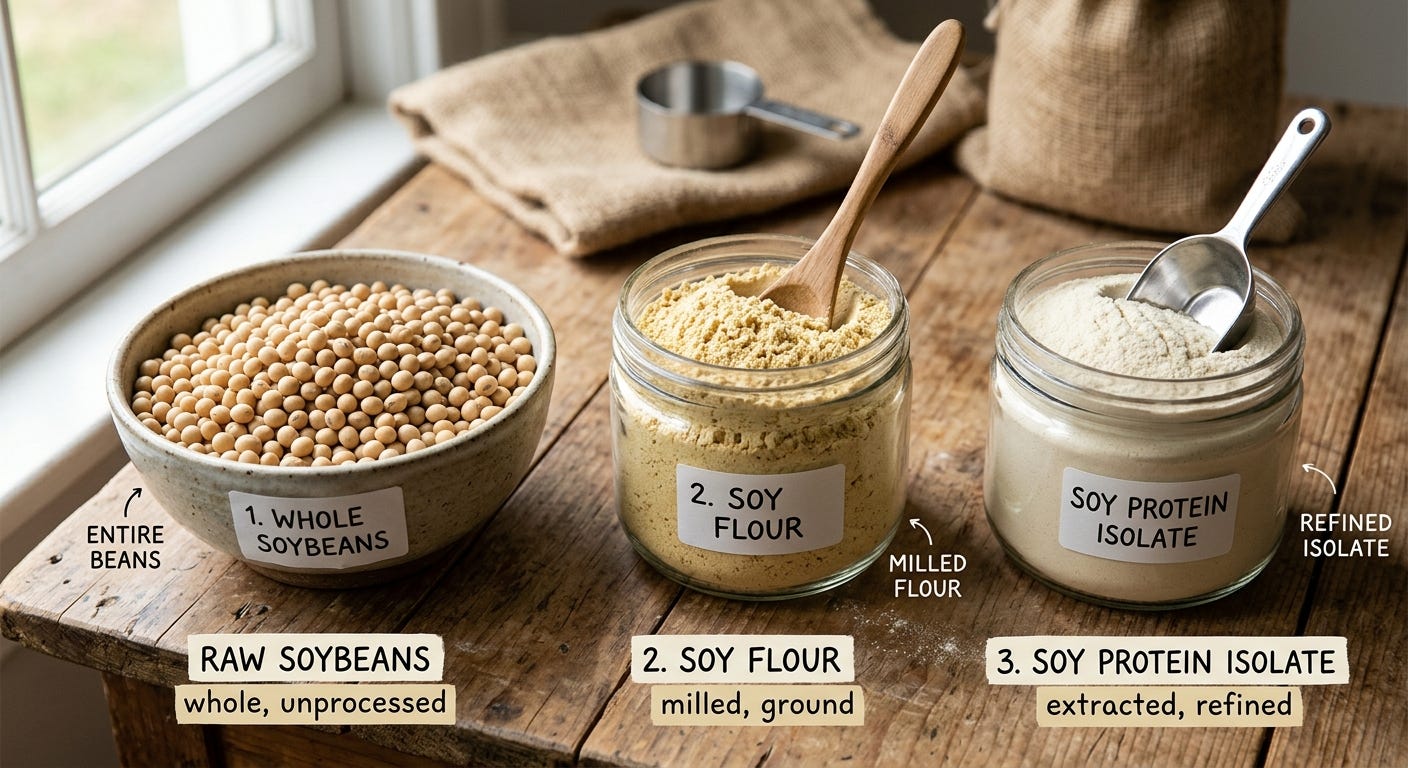
“Soy protein isolate” becoming “soy protein” erases the word that identifies the industrial fractionation process. Products made with protein isolates are classified as UPF under NOVA specifically because of this fractionation. As noted in a 2022 perspective published in Advances in Nutrition by Messina et al., soy-based products containing these isolates meet the NOVA Group 4 classification regardless of their nutritional profile.
Drop the word “isolate,” and you can no longer tell from the label whether a product contains a whole-food soy ingredient or an industrially fractionated one.
Maltodextrin
Maltodextrin is the strongest single illustration of how naming conventions already exploit the gap between regulatory definitions and metabolic reality. It already appears under multiple alternative names, including modified cornstarch, modified food starch, glucose polymer, and dextrin.
Its glycemic index ranges from 85 to 105, depending on processing method and starch source. For comparison, table sugar (sucrose) has a glycemic index of approximately 65; maltodextrin spikes your blood sugar faster than the sugar in your sugar bowl!
Because maltodextrin is classified as a polysaccharide (a complex carbohydrate) rather than a mono- or disaccharide (a simple sugar), products containing it can legally carry “No Added Sugar” claims under current U.S. labeling rules. A fiber supplement labeled “SUGAR-FREE” can contain maltodextrin with a glycemic index higher than table sugar. The metabolic reality is the opposite of what the consumer is led to believe.
The High-Fructose Corn Syrup Precedent
In 2010, the Corn Refiners Association petitioned the FDA to rename high-fructose corn syrup (HFCS) “corn sugar.” The FDA denied the petition on May 30, 2012, in a letter authored by Michael M. Landa, then Director of the FDA’s Center for Food Safety and Applied Nutrition. The FDA’s reasoning was threefold.
First, the term “sugar” describes a solid, dried, crystallized food, and HFCS is a syrup, so the name would not accurately describe the product’s basic nature. Second, “corn sugar” had been used for over 30 years as an alternate name for dextrose, and consumers would confuse the two. Third, individuals with hereditary fructose intolerance had learned to identify HFCS by its current name, and changing it could endanger their health.
The FDA’s reasoning applies directly to the current proposal. When consumers learn to identify a specific ingredient by its regulated name, renaming it means the removal of a tool the consumer has already learned to use.
The Problem With No Common Name
Emulsifiers are the second most frequent UPF marker, appearing in about 36% of all ultra-processed products according to the Neumann et al. (2023) analysis. The names are immediately recognizable to anyone who has started reading labels: polysorbate 80, carboxymethylcellulose, mono- and diglycerides of fatty acids.
There is no common-language equivalent for polysorbate 80, because nothing in a home kitchen does what polysorbate 80 does.
Either the “common name” principle does not apply to emulsifiers, meaning labels would still contain unfamiliar technical names and the stated rationale for the proposal collapses. Or the proposal would require inventing euphemisms for ingredients that have no natural-language equivalent, which is worse than the status quo because it would actively mislead.
The EU Comparison Nestle Doesn’t Want You to See
Under EU rules, if a product contains polysorbate 80, the label must read “emulsifier: polysorbate 80” or “emulsifier: E433.” The consumer knows both what the ingredient is and what it does in the product.
Nestle cites the “vitamin C” part of EU labeling as a model for the U.S. while ignoring the functional-category disclosure requirement that makes the EU system more informative. If transparency were truly the goal, the proposal would advocate for adopting the EU’s functional-category requirement alongside any name simplification. But it doesn’t.
What This Means for You
If you have learned to scan ingredient labels for the markers of ultra-processing, modified starches, protein isolates, emulsifiers, maltodextrin, and other technical terms, this proposal would make it harder for you.
The ingredient list is the last point at which you have full access to what is actually in a packaged food product. The ingredient list, because it is regulated, is the one place where the manufacturer has to tell the truth in specific terms.
The argument this proposal makes is that the ingredient list is too confusing for consumers. The argument the evidence actually supports is that most consumers do not yet use ingredient lists effectively, not because the names are too technical, but because they have not been given the tools to understand them. The response to that gap should be education, not erasure.
Relabel vs. Reformulate
The Reuters article quotes Aldi eliminating dozens of ingredients from its products and Nestle lobbying to rename ingredients it intends to keep. These are presented as if they are part of the same trajectory toward cleaner food.
Aldi’s approach is reformulation: actually changing what is in the product. Nestle’s proposal is relabeling: changing what the consumer sees on the package while the product inside stays the same.
The ingredient label is not the problem to be solved, it is the tool that tells you what the problem is. This proposal treats your ability to identify what is in your food as the obstacle, rather than the right to be protected.
Found this article useful? Share your thoughts. Join the conversation below.
The Metabolic Archives is for educational and informational purposes only, and is not intended as medical advice, diagnosis, or treatment, and does not constitute a doctor-patient relationship. Do not adopt any recommendation discussed in any article or guides published here, make changes or abandon any prescribed medical treatment without prior consultation with your physician. Always seek the advice of your physician or other qualified health provider for any questions regarding your medical condition and recommended treatment options.
By reading this post, you acknowledge that you have read and agree to the Terms of Service of The Metabolic Archives, which govern all use of this content including restrictions on reproduction.
© 2026 The Metabolic Archives. All rights reserved.