
Lifestyle Modification: The Most Powerful Treatment You Were Never Taught
Part Seven: Why Every Failed Diet Leaves Your Metabolism Worse Than Before

Without question healthy dietary habits are one of the most important elements for metabolic health. The next three installments in this series are dedicated to explore this important subject in depth.
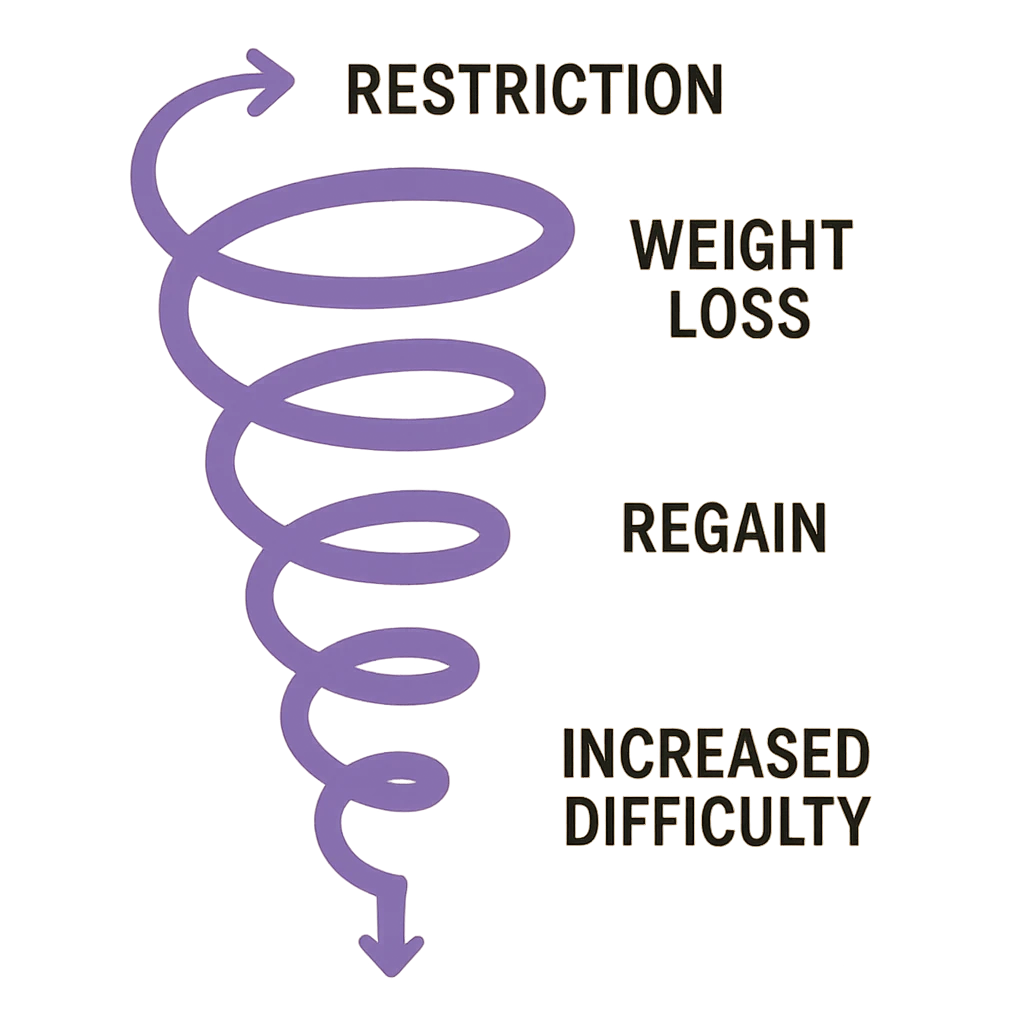
Almost every reader has dieted, most have dieted more than once, the majority did not achieve lasting results and almost none were ever told why. This piece explains what’s the cause of conventional dieting failures and how repeated diet cycles may leave you in a worse metabolic position each time.
Understanding these mechanism is the first step toward escaping it.
Why Your Body Treats Every Diet Like a Famine
When the human body detects caloric intake dropping below weight maintenance needs, it reacts with a predictable compensatory mechanisms to protect against weight loss. Is a basic survival mechanisms rooted in human evolutionary history. In a modern food environment where caloric restriction is voluntary and food is available around the corner, it works against you.
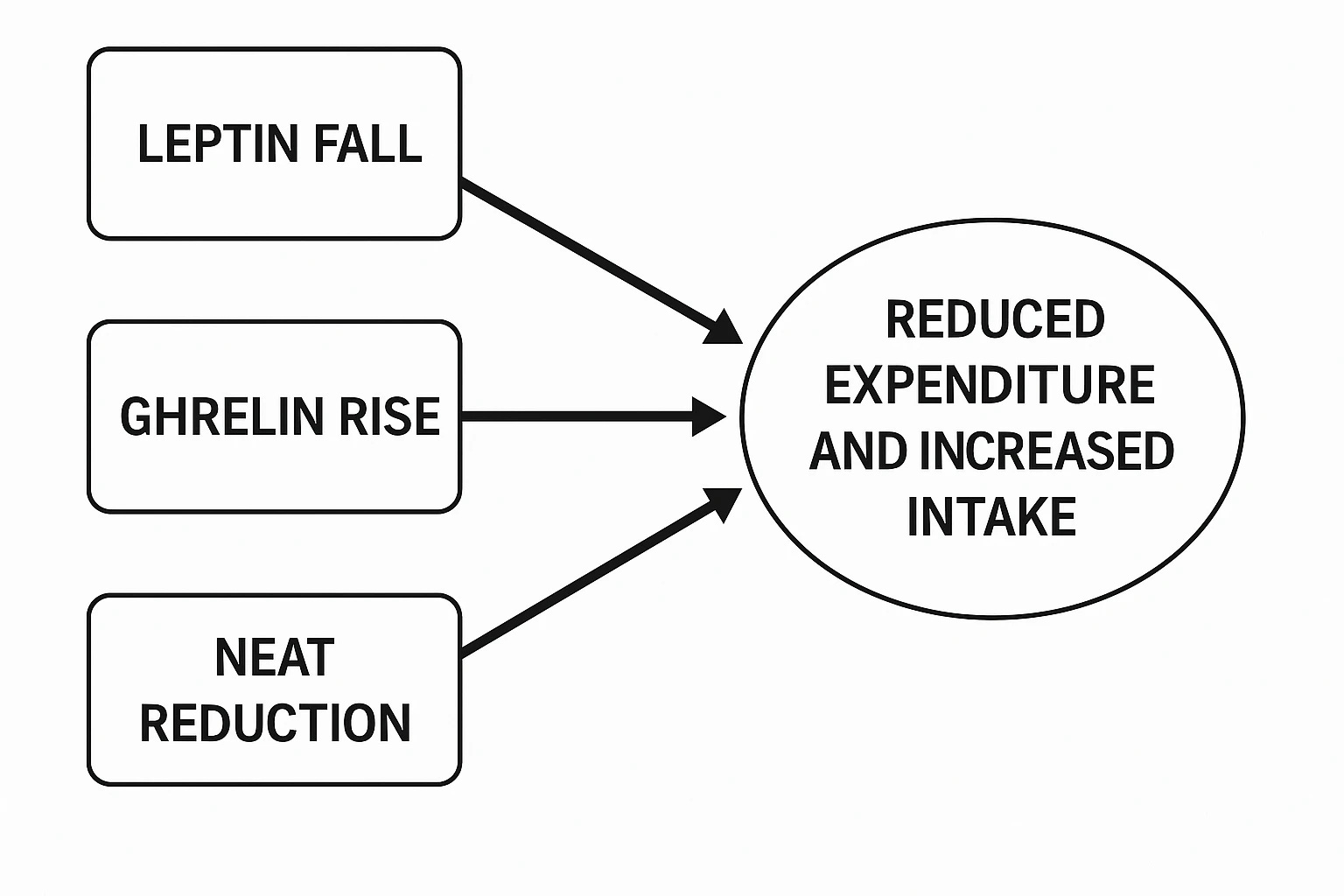
Within days of beginning a caloric restriction diet, a coordinated hormonal counter-response activates across multiple simultaneous pathways.
Leptin falls. Leptin is a hormone produced directly by fat cells, in proportion to how much fat those cells contain. As fat is lost during restriction, fat cells shrink, and leptin production falls with them. The hypothalamus interpret falling leptin as a starvation signal. Its response is to downregulate your metabolism: reducing sympathetic nervous system output, suppressing the hypothalamic-pituitary-thyroid (HPT) axis, and driving down production of triiodothyronine (T3), the active thyroid hormone that governs thermogenesis and metabolic rate. Your body is literally turning down to conserve fuel.
Ghrelin rises. Ghrelin is produced primarily by the stomach and is the most potent hunger-stimulating hormone known. During caloric restriction, ghrelin levels rise and act on the arcuate nucleus of the hypothalamus to powerfully upregulate appetite and food-seeking behavior. You are hungry because this hormonal system is telling your brain to find food.
Non-exercise activity thermogenesis (NEAT) drops. This is the component of daily energy expenditure that most people are unaware of: the calories burned through all movement that is not formal exercise. Under caloric restriction, NEAT drops without conscious awareness. You take the elevator instead of the stairs, sit when you would have stood, stop fidgeting. Studies quantify this reduction at an additional 200 to 400 calories per day beyond the hormonal effects, a meaningful portion of any dietary deficit.
The net result: a body using fewer calories and demanding more food favoring the conditions required to end the diet and restore energy reserves.
The Adaptations That Outlast the Diet
These hormonal and metabolic adaptations do not normalize when the diet ends. A human randomized controlled trial (RCT) documented this: participants who achieved significant weight loss of 13.8 kilograms showed a reduction in resting metabolic rate of 291 kilocalories per day, with an additional adaptive thermogenesis component of 150 kilocalories per day, a total metabolic suppression of approximately 440 kilocalories per day beyond (Thom G et al., Eur J Clin Nutr. 2020). Leptin and glucagon-like peptide-1 (GLP-1) remained reduced, Ghrelin remained significantly elevated. Between six and twenty-four months of follow-up, participants regained an average of 6.1 kilograms despite not reporting increased conscious hunger.
That last point is important: the hormonal drive toward regain was operating below the level of conscious awareness. Participants were not overeating in ways they recognized, they were responding to a biological pressure and regaining weight anyway.
The persistence of elevated ghrelin is documented for up to one year after the end of active weight loss (Thom G, et al., Eur J Clin Nutr. 2020). The person who finishes a diet is operating on a suppressed metabolism with an up-regulated hunger drive, the worst possible conditions for maintaining the weight they just lost.
What Returns Is Not What Left
During caloric restriction, approximately 25% of weight lost comes from lean mass: muscle and other metabolically active tissue, alongside fat. During weight regain, the returning weight is predominantly fat, with only partial lean mass recovery. This asymmetry has been documented in human data. In a five-month nutritional trial of women with obesity aged 50 to 70, for every kilogram of fat lost during the intervention, 0.26 kilograms of lean tissue was simultaneously lost. For every kilogram of fat regained during the following year, only 0.12 kilograms of lean tissue was recovered (Zamboni M, et. al., Rev Endocr Metab Disord. 2025;26).
The person who returns to their starting weight after a failed diet is carrying more fat and less muscle than before they began. Their resting metabolic rate is lower. Their body now requires fewer calories to maintain its current weight than it did before the diet started.
If you enjoy evidence-based medical information, subscribe to receive these articles delivered to your mailbox every week.
The Compounding Effect: Why Each Cycle Is Harder
A 2024 systematic review by Sanaya, Janusaite, Dalamaga, and Magkos at the University of Copenhagen, published in Current Obesity Reports, evaluated 23 studies and concluded that the overwhelming majority of evidence does not associate weight cycling with adverse effects on body composition or metabolic rate. This conclusion has received significant attention and criticism from the scientific community. The majority of included studies used inadequate follow-up durations, most relied on self-reported weight history rather than validated body composition measurement, the analysis did not stratify by number of cycling episodes, a critical omission if a dose-response relationship exists. Older populations, in whom the body composition consequences are most pronounced, were substantially underrepresented.
The studies that do use validated body composition methods, longer follow-up periods, and older populations tell a more consistent and concerning story. Weight cycling is associated with progressive central fat deposition, enhanced inflammatory response in adipose tissue, with macrophage infiltration and increased production of pro-inflammatory mediators. Repeated glucose fluctuation and hyperinsulinemia place escalating burden on pancreatic beta cells and increasing cardiovascular risk across cycles (Dulloo AG, Rev Endocr Metab Disord. 2025;26). In older populations specifically, weight cycling is associated with acceleration of age-related lean mass loss, and with sarcopenia and sarcopenic obesity when evaluated using validated strength and body composition measures.
A Special Note for Patients With Significant Obesity
Everything described above scales with the severity of restriction required to produce meaningful weight loss. For patients who need to lose large amounts of weight, the gap between current maintenance calories and target weight maintenance calories may be large enough that dietary modification alone triggers a biological response too powerful to overcome through behavioral change alone.
If you have significant weight to lose, unsupervised caloric restriction is not the right starting point. The appropriate strategy is professional medical supervision to define individual caloric targets based on your specific metabolic situation, and to evaluate whether adjuvant pharmacological or surgical intervention is indicated alongside the lifestyle foundation.
Calculating Your Target: One Tool Worth Using Correctly
Before Part Seven builds the practical framework for what to eat, one foundational concept belongs here.
Most people who attempt caloric restriction calculate their daily needs using their current weight. This produces the caloric intake required to sustain current weight not for weight loss The correct approach is to calculate daily caloric needs at your target weight.
The most validated tool available for this calculation is the Mifflin-St Jeor equation for resting metabolic rate (RMR). Across multiple independent validation studies, Mifflin-St Jeor consistently outperforms competing equations including Harris-Benedict and the World Health Organization (WHO) formula in accuracy against gold-standard indirect calorimetry, correctly predicting RMR within 10% of measured values in 82% of subjects (Frankenfield D, et al., J Am Diet Assoc. 2005 and Rocha KF, et al., Medicine. 2024).
The formula:
For men: RMR = (10 x weight in kg) + (6.25 x height in cm) - (5 x age in years) + 5
For women: RMR = (10 x weight in kg) + (6.25 x height in cm) - (5 x age in years) - 161
Use your target weight in kilograms, not your current weight, in this calculation.
The result is your resting metabolic rate: the calories your body requires at complete rest. To estimate total daily energy expenditure (TDEE), multiply by the activity factor that best reflects your typical day:
Sedentary (desk work, minimal movement): RMR x 1.2
Lightly active (light exercise 1-3 days per week): RMR x 1.375
Moderately active (moderate exercise 3-5 days per week): RMR x 1.55
Very active (hard exercise 6-7 days per week): RMR x 1.725
The number you arrive at is your daily caloric target: the intake required to achieve your target weight. Keeping daily caloric limit at, or below, this number from the outset creates the required caloric deficit needed for gradual weight loss.
Keep in mind the limitations: accuracy is lower in individuals with obesity (approximately 75% versus 87% in non-obese individuals) meaning the equation performs less precisely in the population most likely to be using it. Also the activity multiplier is itself an estimation, adding a second layer of approximation to the calculation. The result is a useful, evidence-based starting point, but not precise.
For anyone who needs greater precision, indirect calorimetry is the gold standard for RMR assessment and is available through clinical weight management programs. If you are working with a medical team, it is worth asking whether it is available to you.
The US National Institutes of Health clinical guidelines on obesity recommend a safe rate of weight loss of approximately 1–2 pounds per week.
The Exit Is Not Another Diet
The biological picture is now complete.
Part Seven introduces the actual diet footprint. Not a meal plan you will follow for six weeks and abandon, but a structure for making food choices you can sustain indefinitely: gives you the tools to build a way of eating that belongs to you.
Found this article useful? Share your thoughts. Join the conversation below.
Educational content on The Metabolic Archives is free, because medical information should be accessible to everyone. If you find value and want to support the work, a paid subscription is available and genuinely appreciated. Visit the About Page for additional information.
The Metabolic Archives is for educational and informational purposes only, and is not intended as medical advice, diagnosis, or treatment, and does not constitute a doctor-patient relationship. Do not adopt any recommendation discussed in any article or guides published here, make changes or abandon any prescribed medical treatment without prior consultation with your physician. Always seek the advice of your physician or other qualified health provider for any questions regarding your medical condition and recommended treatment options.
By reading this post, you acknowledge that you have read and agree to the Terms of Service of The Metabolic Archives, which govern all use of this content including restrictions on reproduction.
© 2026 The Metabolic Archives. All rights reserved.