
Lifestyle Modification: The Most Powerful Treatment You Were Never Taught
Part Eleven. The Science of Exercise and Why Movement Is Medicine

Your body was built for almost constant low-level movement across the entire waking day, and the modern world has quietly removed that movement one convenience at a time. The cost of that removal is real, and a single daily workout does not cancel it. This piece explains what exercise actually does inside your body, how daily life came to remove movement out of existence, and why getting it back takes more than a gym membership.
The Prescription Without an Explanation

For decades exercise has been handed out the same way as every other lifestyle instruction in this series: as a command without a reason, move more, be active, get your steps in. While superficially useful, it leaves out the part that actually changes behavior, which is understanding why it matters and what it is doing to you on the inside.
For anyone managing insulin resistance, high blood glucose, or metabolic syndrome, this is not an optional lifestyle add-on, is a foundational treatment strategy.
What Exercise Actually Does Inside Your Body
Your muscles are the main place blood glucose goes
The carbohydrate in your meal becomes glucose in your bloodstream and the single largest destination is your skeletal muscle. Skeletal muscle accounts for roughly 80% of the glucose your body clears from the blood under the influence of insulin after a meal (Richter and Hargreaves, Physiological Reviews, 2013).
This is why insulin resistance is, at its core, largely a muscle problem. When muscle becomes resistant to insulin, that main destination for blood glucose stops up taking it efficiently. Glucose backs up in the blood and the pancreas responds by pumping out more insulin to compensate, and the cycle that drives metabolic syndrome forward is underway. Muscle is not a cosmetic concern in metabolic disease, is the primary place where resistance plays out, and the primary place you can intervene.
The back door insulin resistance cannot lock
Insulin normally works like a key: it arrives at the muscle cell setting off steps inside the cell that ends with transporters molecules called glucose transporter type 4 (GLUT4) moving to the cell surface; those transporters let glucose in. In insulin resistance, several steps break at different points inside the cell. Glucose remains in the bloodstream even though insulin is present and often in large amounts.
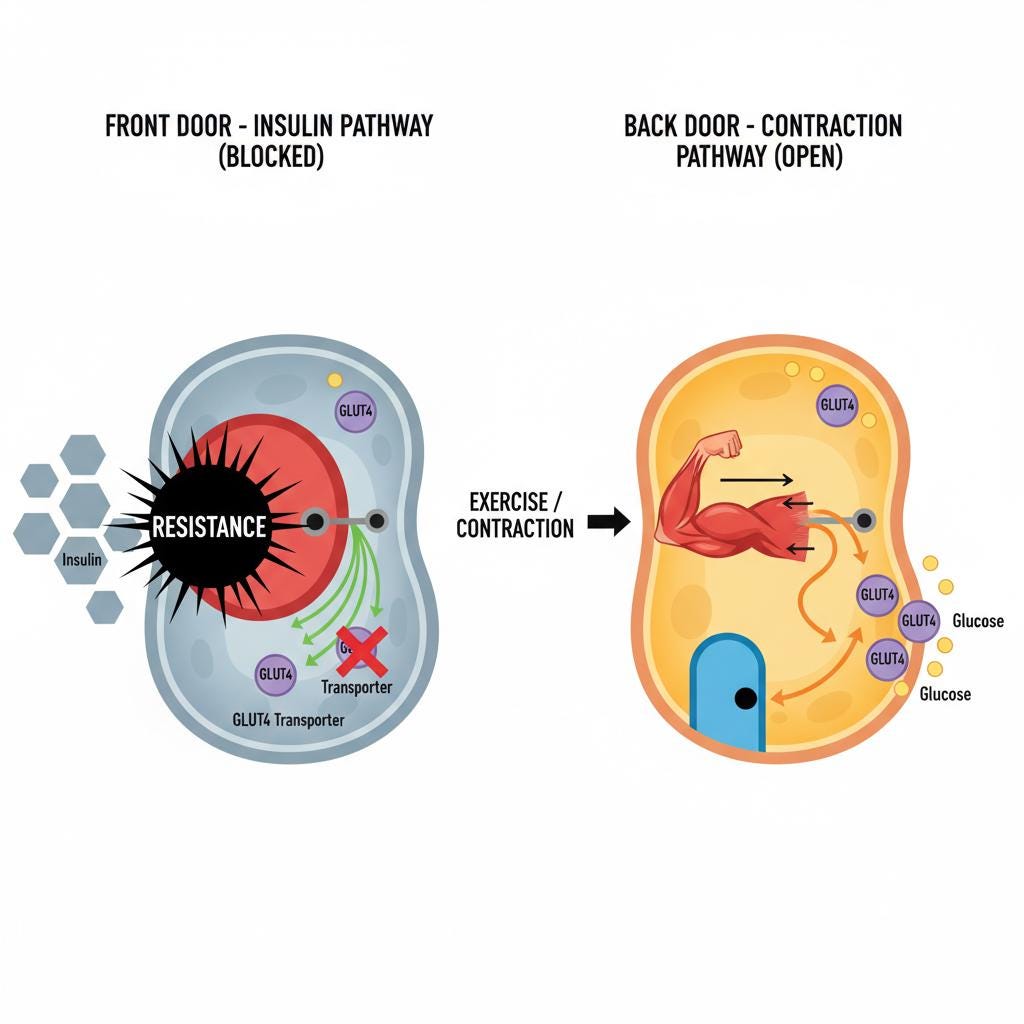
When a muscle cell contracts it consumes adenosine triphosphate (ATP), and as that fuel is spent its breakdown product, adenosine monophosphate (AMP), accumulates. That shift activates an enzyme complex, adenosine monophosphate-activated protein kinase (AMPK). Once activated, this complex moves GLUT4 transporters to the cell surface through a different mechanism bypassing insulin’s broken chain (Sylow et al., Nature Reviews Endocrinology, 2017).
Regular training raises the total number of GLUT4 transporters stored inside the muscle, so the pool available grows the longer you keep at it (Richter and Hargreaves, Physiological Reviews, 2013).
Exercise calms the inflammation that feeds the disease
Contracting muscle does more than burn fuel, it releases signaling proteins called myokines, including interleukin-6 and interleukin-10, that travel through the body and reduce inflammation. Chronic, low-grade inflammation is one of the central drivers of insulin resistance and the progression of metabolic syndrome, exercise is a direct treatment. Regular exercise lowers C-reactive protein (CRP), a standard blood marker of inflammation, and works on the same inflammatory pathway that drives metabolic disease (Cureus, 2024).
Just breaking up sitting helps immediately
You do not need a structured workout to get a measurable benefit. Interrupting long periods of sitting with brief bouts of light activity improved after-meal blood glucose responses by about 18% and insulin responses by about 25% compared with sitting still without breaks (Physiological Reviews, 2023).
How the Modern World Engineered Movement Out of Your Day
The sedentary life is the predictable result of an environment that has systematically removed movement from ordinary living. Your body evolved for steady low-level activity across the whole day.
Screens replaced motion. Television, streaming, and smartphones converted leisure time that used to involve walking, playing, or working in the yard into hours spent sitting.
Cars replaced walking. American cities and suburbs were built around the automobile; a trip that once took physical effort now takes none.
Sprawl made walking impractical. Separating homes from stores and workplaces makes walking between them impossible for most people.
Desk work replaced physical work. The shift to knowledge work put most of the workforce in a chair for the bulk of the day.
Elevators replaced stairs. Stairs exist in nearly every building and are used by almost no one.
Remote work removed the commute. Working from home erased even the small movement of getting to an office and walking its halls.
Labor-saving technology removed the rest. Dishwashers, robot vacuums, home delivery, and ride-sharing each eliminated a little more of the light daily activity that previous generations did.
The Real Cost of Sitting Still
Physical inactivity is associated with about 1 in 10 premature deaths in the United States, roughly 280,000 deaths a year (Carlson et al., Centers for Disease Control and Prevention analysis). It is associated with about $117 billion in annual healthcare costs, close to 11% of all healthcare spending in the country (Carlson et al., Progress in Cardiovascular Diseases, 2015; Physical Activity Guidelines for Americans, 2nd edition, 2018). And only about 1 in 4 American adults, roughly 24%, meet the recommended guidelines for both aerobic and muscle-strengthening activity, about 80% of us fall short (Physical Activity Guidelines for Americans, 2nd edition, 2018).

Greater time spent sitting was associated with a 73% higher chance of having metabolic syndrome, a finding that held steady across sex, across different definitions of the syndrome, and across countries of different income levels (meta-analysis of cross-sectional studies, 2012). Experimental studies back this up: deliberately increasing how much people sit reduced their insulin sensitivity by 17% to 58% within days (Physiological Reviews, 2023).
Prolonged sitting is a metabolic risk on its own. A morning workout does not fully compensate for the metabolic damage of the eight sedentary hours that follow.
Exercise Is Not an Event
The common understanding of exercise, a scheduled workout after which your metabolic duty is discharged, is incomplete and, for someone managing metabolic disease, insufficient. Metabolic damage from continuous sitting accumulates throughout the day; brief frequent movement breaks produce real benefits.
Strive to add consistent movement through every hour, in whatever forms your life allows:
Park at the far end of the lot and walk.
Take the stairs whenever the option exists.
Walk to nearby stores and destinations instead of driving.
Stand up periodically through the workday, during phone calls and meetings where it is feasible.
Walk after meals.
Walk the longer route when one is available.
Each one reduce continuous sitting and increase your total daily movement. The evidence shows that this is a distinct benefit, separate from and additional to whatever structured workout you already do.
If you enjoy evidence-based medical information, subscribe to receive these articles delivered to your mailbox every week.
What Consistent Movement Does for You

Blood glucose and insulin resistance
Exercise helps in two ways at once.
There is the immediate effect, insulin-independent glucose transport activation with every contraction pulling glucose into muscle during and after each session. And there is the long-term adaptation, more GLUT4 transporters, better insulin signaling, less inflammation.
In the Diabetes Prevention Program, a landmark US randomized trial, a lifestyle program built on roughly 150 minutes of activity per week plus modest weight loss cut the rate of new type 2 diabetes by 58% over about three years (Knowler et al., New England Journal of Medicine, 2002). Both aerobic exercise and resistance training improve blood glucose control, and combining the two tends to work best. The American College of Sports Medicine confirms that exercising after meals lowers blood glucose regardless of the intensity or type, which turns every post-meal walk into a therapeutic act (Kanaley et al., Medicine and Science in Sports and Exercise, 2022).
Heart and blood vessels
Exercise improves the function of the lining of your blood vessels by increasing nitric oxide, a molecule that relaxes and widens them. It reduces arterial stiffness, shifts the nervous system toward its rest setting, and lowers resting heart rate. Resistance training alone lowered the top number of blood pressure (systolic) by about 4 points and the bottom number (diastolic) by about 2 points in middle-aged and older adults, reductions that are clinically meaningful and achieved without a single pill (American Heart Association Scientific Statement, Circulation, 2023). It also raises high-density lipoprotein (HDL) cholesterol and lowers triglycerides.
Fatty liver disease
Fatty liver, now called metabolic dysfunction-associated steatotic liver disease (MASLD), responds to exercise in a way that is not explained by weight loss alone. In a controlled study, exercise reduced liver fat and liver stiffness beyond what the amount of weight lost would predict, along with a roughly 16% improvement in a combined liver-fat-and-injury score (Oh et al., JHEP Reports, 2021). The benefit tracked with preserved muscle, greater strength, and less oxidative stress, independent of pounds lost. The 2024 international guideline from the European Association for the Study of the Liver (EASL), the European Association for the Study of Diabetes (EASD), and the European Association for the Study of Obesity (EASO) explicitly recommends exercise to reduce liver fat, targeting more than 150 minutes per week of moderate activity or 75 minutes of vigorous activity (EASL-EASD-EASO Clinical Practice Guideline, Journal of Hepatology, 2024).
Weight management
Exercise contributes to weight loss through increased energy expenditure, but a more important role is protecting your lean muscle while you lose weight. As covered in Part Six, dieting without exercise tends to strip away muscle along with fat, which quietly worsens your metabolism over time. Exercise is the main thing that preserves muscle during weight loss, regardless of how fast you lose.
Living longer
Cardiorespiratory fitness, your body’s ability to use oxygen during sustained effort measured as maximal oxygen uptake (VO2 max), is among the strongest predictors of how long you will live. In a 2022 analysis of more than 750,000 US veterans, each one-step improvement in fitness, measured in units called metabolic equivalents (MET), was associated with a 13% to 15% lower risk of dying, regardless of age, body mass index (BMI), sex, or other illnesses (Kokkinos et al., Journal of the American College of Cardiology, 2022).
Combining aerobic exercise with resistance training was associated with about a 40% lower risk of death from any cause compared with being inactive, the largest such benefit seen for any exercise combination. In some analyses, low fitness carried a greater risk of death than smoking.
Cancer
A 2025 meta-analysis pooling close to 1.5 million cancer patients found that physical activity after diagnosis was associated with substantially lower odds of dying from cancer: about 31% lower for breast cancer, 27% lower for prostate cancer, 24% lower for lung cancer, and 29% lower for colorectal cancer (Ungvari et al., GeroScience, 2025). Those are only associations drawn from observed groups rather than controlled experiments.
In 2025 the CHALLENGE trial, a randomized controlled trial (RCT), tested a structured three-year exercise program in people who had completed surgery and chemotherapy for colon cancer. Exercise reduced the risk of cancer recurrence or death by 28%, and about 80% of the exercise group remained cancer free at five years compared with about 74% of the comparison group (Courneya et al., New England Journal of Medicine, 2025). This is the first randomized trial proving that exercise can reduce cancer recurrence. Plausible mechanisms include lower inflammation, better immune surveillance, lower circulating insulin and estrogen, and a direct slowing of cancer cell growth.
Brain and memory
Exercise raises a protein called brain-derived neurotrophic factor (BDNF), which supports the growth of new neurons in the memory center maintaining the connections between them. Aerobic exercise drives this through one set of pathways, and resistance training through another involving insulin-like growth factor 1 (IGF-1) and growth hormone. A 10-week resistance training program raised BDNF by about 65% in older adults, linked to better memory (Frontiers in Aging Neuroscience, 2022). The benefit is most pronounced in older adults and in preventing age-related decline.
Mood and depression
A 2024 umbrella review pulling together 27 prior reviews found a moderate-to-large effect on depressive symptoms, with a number needed to treat of about 2.8 (Journal of Affective Disorders, 2024). In plain terms it means that about 33% of people who take up exercise improve, a remarkably strong result for any treatment. A 2022 network analysis found no meaningful difference between exercise and antidepressant medication for reducing symptoms in people with mild to moderate depression (Recchia et al., British Journal of Sports Medicine, 2022). Exercise is now a recommended first-line treatment for mild to moderate depression in Canadian and British national guidelines.
For moderate to severe depression, the evidence supports adding exercise to medical treatment, not replacing it. The evidence does not support stopping treatment in favor of exercise alone.
Bones
Weight-bearing exercise, especially resistance training, is the single most effective non-pharmacological way to preserve and build bone. The mechanical load of pulling and pushing against resistance stimulates bone-building. The evidence is strongest in women after menopause, when falling estrogen accelerates bone loss.
Sleep
Regular moderate exercise improves sleep quality, helps you fall asleep faster, and increases deep, restorative sleep.
Stress
Exercise lowers the stress hormone cortisol over time and acutely raises the brain chemicals tied to well-being. Chronic stress and metabolic disease feed each other, and adding exercise strengthens the stress-reduction strategies in the stress installment of this series.
Emerging Evidence For Gut Health
New evidence suggests regular exercise may improve the diversity of the bacteria in your gut and shift their makeup in a favorable direction. But this remains uncertain: more than half of human studies find no measurable change in gut bacteria diversity, and the results vary widely (Cullen et al., Frontiers in Physiology, 2023).
This is a biologically plausible and emerging possibility, not yet an established fact.
Everything Reinforces Everything Else
Step back and the integrated picture comes into focus. Exercise is not just one item on the list of things that support metabolic health, is the intervention that amplifies every other item at the same time.
It begins not at the gym, but the moment you choose the stairs. Part Twelve will show you exactly what to do next.
Found this article useful? Share your thoughts. Join the conversation below.
Educational content on The Metabolic Archives is free, because medical information should be accessible to everyone. If you find value and want to support the work, a paid subscription is available and genuinely appreciated. Visit the About Page for additional information.
The Metabolic Archives is for educational and informational purposes only, and is not intended as medical advice, diagnosis, or treatment, and does not constitute a doctor-patient relationship. Do not adopt any recommendation discussed in any article or guides published here, make changes or abandon any prescribed medical treatment without prior consultation with your physician. Always seek the advice of your physician or other qualified health provider for any questions regarding your medical condition and recommended treatment options.
By reading this post, you acknowledge that you have read and agree to the Terms of Service of The Metabolic Archives, which govern all use of this content including restrictions on reproduction.
© 2026 The Metabolic Archives. All rights reserved.
© 2026 The Metabolic Archives. All rights reserved.