
Modified Citrus Pectin- Separating the Science from the Claims
What the research shows, what it doesn’t, and why that distinction matters

The part of the orange nobody eats turns out to be the part the supplement industry finds most interesting. In its natural state, pectin passes through your gut largely intact, doing what dietary fiber does. Modified citrus pectin (MCP) is native pectin that has been processed in a laboratory using heat and alkaline conditions to break it into shorter fragments, specifically to allow some portion of it to be absorbed from the gut into systemic circulation.

What Galectin-3 Actually Does
Galectin-3 is a beta-galactoside-binding lectin, a protein that attaches to specific sugar structures on the surface of cells and in the spaces between them. It performs legitimate functions in wound healing, immune activation, and normal tissue repair; the problem is what it does when those processes go wrong.
In cancer biology, galectin-3 is upregulated across multiple tumor types and has well-characterized roles in tumor cell aggregation, adhesion to the extracellular matrix, resistance to programmed cell death (apoptosis), angiogenesis, and evasion of immune surveillance (Glinsky and Raz, Carbohydr Res. 2009;344(14):1788-91).
In fibrotic disease, galectin-3 drives macrophage polarization toward a profibrotic phenotype and promotes the activation of myofibroblasts, the cells responsible for pathological collagen deposition in the liver, lung, and kidney (Glinsky and Raz, 2009).
In cardiovascular disease, elevated circulating galectin-3 is associated with adverse outcomes in heart failure, and the U.S. Food and Drug Administration (FDA) has cleared galectin-3 as a biomarker for heart failure risk stratification.
What MCP Is and How It Gets There
Native citrus pectin is a high-molecular-weight polysaccharide. The modification process uses controlled heat and alkaline pH to reduce molecular weight and degree of esterification, generating shorter galactan chain fragments with improved bioavailability (Leclere et al., Front Pharmacol. 2013;4:128).
Some of those fragments do reach the bloodstream after oral dosing. However the pharmacokinetic questions, and the data required to answer them has not been generated to any rigorous standard. The available pharmacokinetic literature is predominantly produced by or associated with manufacturers of MCP products, uses proxy measures rather than direct tissue concentration assays, and has not been independently replicated (Leclere et al., 2013).
Before any MCP fragment reaches the circulation, it passes through the gut microbiome, where bacteria ferment pectin and alter its molecular composition. The extent to which microbial fermentation changes the identity and activity of the circulating fragments varies between individuals and has not been characterized.
What the Wellness Industry Claims
The claims attached to MCP in the wellness and supplement space fall into several distinct categories.
Anti-cancer claims hold that MCP inhibits tumor metastasis, slows cancer progression, reverses immune evasion, and enhances the effectiveness of chemotherapy. Specific claims for prostate cancer invoke PSA (prostate-specific antigen) doubling time prolongation as evidence of anti-tumor activity. Anti-metastatic claims are made broadly across cancer types.
Antifibrotic claims hold that MCP reduces organ fibrosis in the liver and elsewhere, making it relevant for conditions including non-alcoholic fatty liver disease and metabolic dysfunction-associated steatohepatitis (MASH).
Cardiovascular claims hold that MCP lowers circulating galectin-3 levels and by extension reduces cardiovascular risk.
Heavy metal chelation claims hold that MCP binds heavy metals and facilitates their elimination from the body.
General immune modulation and anti-aging claims hold that MCP reduces systemic inflammation, combats “inflammaging,” and supports general immune function.
These claims are presented as established fact, often citing the same small set of studies repeatedly. What those studies actually show is a different matter.
What the Research Actually Shows
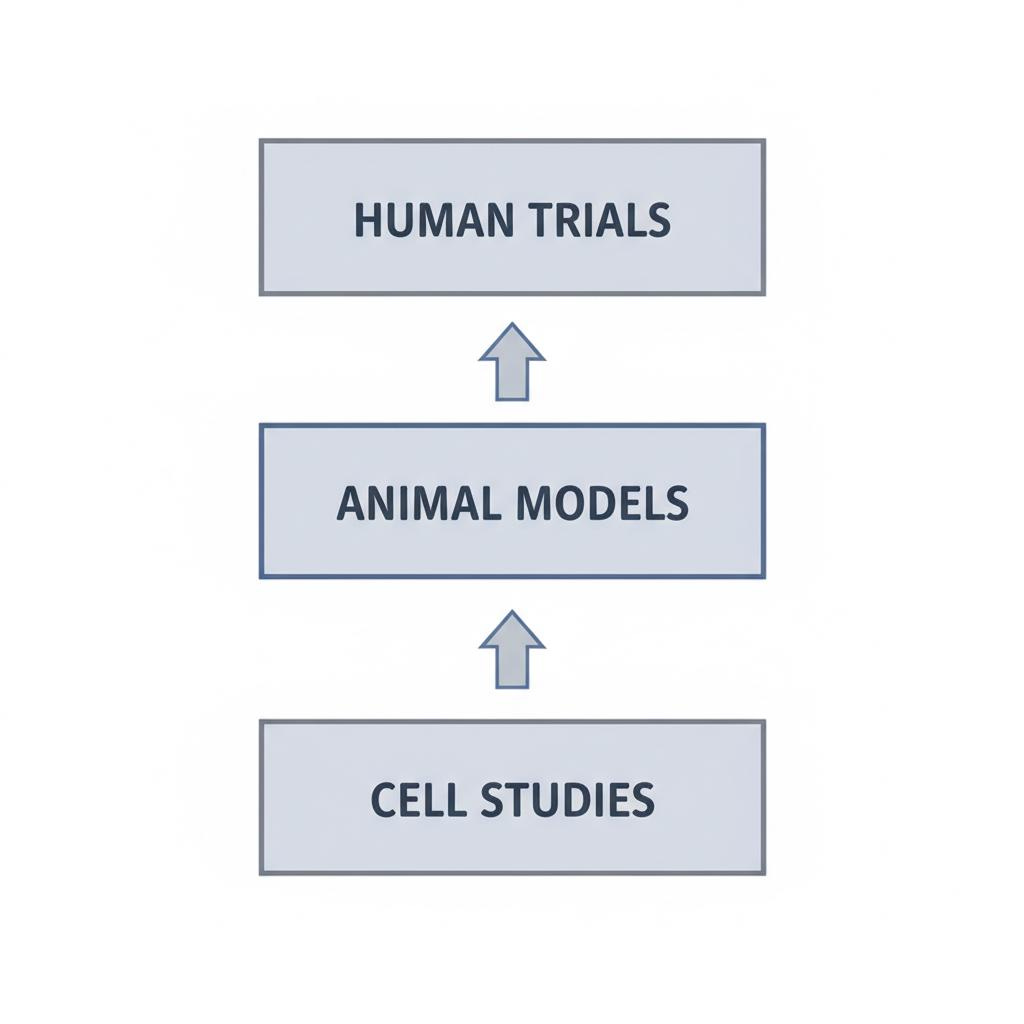
Cell Studies and Animal Models
The preclinical evidence for MCP is reasonably consistent. Cell line studies across prostate, breast, colon, bladder, ovarian, and melanoma models have demonstrated that MCP reduces tumor cell adhesion, invasion, and angiogenesis while increasing apoptosis (Glinsky and Raz, 2009; Hossein et al., Cancer Med. 2019;8(9):4315-29; Fang et al., Acta Pharmacol Sin. 2018;39(12):1885-93). Synergy with paclitaxel in ovarian cancer spheroids and with other chemotherapy agents in respective experimental systems has been reported. Animal models have extended these findings into living systems, showing reduced tumor growth and metastatic spread in rodent models.
The effects observed in cell culture were produced at concentrations that have not been demonstrated to be achievable in human plasma or target tissue after oral supplementation. The two findings exist in different evidentiary worlds, and the supplement industry routinely collapses that distinction. Animal-to-human translation in oncology also has a well-documented failure rate. Approximately 95% of drugs that demonstrate meaningful anticancer activity in rodent models fail to demonstrate benefit in human trials.
If you enjoy evidence-based medical information, subscribe to receive these articles delivered to your mailbox every week.
Human Evidence: The Full Account
Prostate cancer. The most-cited human oncology study is a prospective phase II trial by Keizman et al. (Nutrients. 2021;13(12)) enrolling 60 patients with non-metastatic, biochemically relapsed prostate cancer. Patients received PectaSol-C at 4.8 grams three times daily for six months. The study reported prolongation of PSA doubling time in a proportion of patients.
Two problems: first, the study had no concurrent control arm. Historical controls were used for comparison, which introduces substantial confounding from patient selection, changes in background treatment patterns, and regression to the mean. Without randomization and a concurrent placebo group, the PSA doubling time changes observed cannot be attributed to MCP.
Second, PSA doubling time is a surveillance parameter, not a tumor activity measurement. It influences clinical decisions about when to intervene, but it does not directly measure tumor burden, metastatic potential, or disease progression. Using PSA doubling time prolongation in an uncontrolled study to support an anti-metastatic claim is measuring a variable that cannot answer the question being asked.
Advanced solid tumors. A 2007 prospective pilot study by Azemar et al. (Clinical Medicine Oncology. 2007;1:73-80) enrolled 49 patients with advanced, mixed solid tumor types. There was no randomization, no control arm, and no standardized endpoint definition. The study is hypothesis-generating at best but cannot support efficacy claims for any tumor type.
The unresolved phase III trial. A phase III trial (NCT01681823) was registered and apparently conducted. As of the time of this writing, no peer-reviewed outcome data has been published.
Cardiovascular biomarkers. The most credible human data in the MCP literature comes from a study by Lau et al. (JACC Basic Transl Sci. 2021;6(1):12-21) examining MCP in hypertensive patients. MCP was associated with reductions in circulating galectin-3 levels. This is the best human evidence available and it demonstrates a biomarker effect. Whether galectin-3 reduction through MCP supplementation translates into fewer cardiovascular events, reduced hospitalizations, or mortality benefit is entirely unknown.
The Funding Problem
EcoNugenics, the manufacturer of PectaSol-C, has financial involvement in a substantial proportion of the human clinical literature on MCP. Supplement research operates without the pre-registration requirements, protocol adherence mandates, and independent data monitoring obligations that apply to pharmaceutical trials. The evidence base and the commercial interest are not separate entities in this literature. That does not make the studies fabricated, but it is a material fact about how they should be weighted.
The Pharmaceutical Industry as Calibration
The most important context the supplement industry fails to mentions is this: the pharmaceutical industry has spent years developing purpose-built galectin-3 inhibitors with defined binding affinity, characterized pharmacokinetics, and known tissue concentrations. They are engineered small molecules and biologics designed specifically to inhibit galectin-3 at therapeutically relevant concentrations.
GB0139, an inhaled galectin-3 inhibitor developed by Galecto Biotech, was tested in a phase 2b randomized controlled trial (GALACTIC-1, NCT03832946) in 173 patients with idiopathic pulmonary fibrosis (IPF). The primary endpoint, reduced rate of decline in forced vital capacity (FVC), was not met. Serious adverse events occurred in 7.8% of the treatment group versus 1.4% in the placebo group. Development was discontinued in August 2023.
Belapectin, a galectin-3 inhibitor developed by Galectin Therapeutics, was tested in the NAVIGATE trial (NCT04365868), a 355-patient, randomized, double-blind, placebo-controlled trial conducted across 130 sites in 15 countries. The primary endpoint was prevention of new esophageal varices in patients with MASH cirrhosis. The primary endpoint was not met in the intent-to-treat population. A pre-specified per-protocol subgroup showed a 49% reduction in new varices; a U.S. subgroup showed a 68% reduction. Updated biomarker data presented at the American Association for the Study of Liver Diseases (AASLD) annual meeting in 2025 showed reductions in fibrosis markers Pro-C3, PRO-C4, and YKL-40, suggesting biological activity. Subgroup analyses from a failed primary endpoint trial, however, are hypothesis-generating and not confirmatory. Development is not over for belapectin, but has not yet demonstrated actual clinical benefit.
The relevant question for MCP is this: if purpose-engineered galectin-3 inhibitors administered at known concentrations through optimized delivery routes are struggling to demonstrate clinical benefit under rigorous trial conditions, what is the realistic expectation for an oral polysaccharide supplement with uncharacterized bioavailability?
Verdict by Claim Category
Anti-metastatic and anti-tumor claims. Not supported by human evidence. The preclinical data is consistent and biologically plausible. The human data consists of one uncontrolled phase II study in prostate cancer using a surrogate endpoint that cannot answer the metastatic question, one uncontrolled pilot in heterogeneous solid tumors, and a completed phase III trial without published results. No efficacy claim for cancer prevention, treatment, or metastasis inhibition is justified by this evidence base.
Chemotherapy synergy claims. Demonstrated in cell culture and animal models. Not evaluated in any adequately designed human trial. The claim is plausible but clinically unproven. There are also theoretical concerns about whether galectin-3 inhibition could interfere with immune-mediated tumor killing in the context of immunotherapy, which has not been studied.
Antifibrotic claims. Plausible, supported by animal data, and tested in the pharmaceutical pipeline through belapectin, which failed its primary endpoint. No adequate human evidence exists to support an antifibrotic claim for MCP supplementation.
Cardiovascular claims. The galectin-3 biomarker reduction observed by Lau et al. (2021) in hypertensive patients is the most credible human evidence in the MCP literature. A biomarker reduction is not a cardiovascular outcome, whether this translates into clinical benefit is unknown.
Heavy metal chelation claims. Dietary fiber can adsorb heavy metals within the gut lumen and reduce their absorption; a process of gut-lumen binding, not chelation. Once heavy metals are in systemic circulation and deposited in tissues, an oral polysaccharide fiber has no plausible mechanism to reach them. The term “chelation” implies systemic metal removal, which requires compounds capable of entering tissues and forming stable metal-ligand complexes for urinary excretion. Pectin is not such a compound.
Immune modulation and anti-aging claims. No adequate human evidence. Theoretical and speculative beyond the galectin-3 pathway.
The consistent pattern across all claim categories is the same: the gap between cellular mechanics and clinical proof has not been closed, and the evidence required to close it has not been generated.
Where That Leaves You
MCP is not a proven treatment for cancer, fibrosis, cardiovascular disease, or heavy metal toxicity. The standard of evidence required to recommend it as a treatment has not been met. The desire for additional promising treatment is understandable and legitimate. What you deserve is an accurate account so that your decisions are based on evidence rather than on unproven claims.
If you are considering MCP, a few things are worth knowing. Its short-term safety profile at typical supplement doses is acceptable, however the drug interaction profile is real. MCP can impair absorption of tetracyclines, digoxin, thyroid hormones, and mineral supplements, and should be separated from these by at least two hours. Any supplement use should be discussed with your treating physician, who can review your specific medication list and advise on timing.
MCP occupies a specific and honest position: a compound with interesting cellular mechanisms, a preclinical record worth taking seriously, a human evidence base that is small and methodologically inadequate, and an unresolved pharmacokinetic problem that sits at the center of every efficacy claim made about it. The pharmaceutical industry’s experience with purpose-built galectin-3 inhibitors is the most honest evidence available for what MCP can realistically be expected to do.
Found this article useful? Share your thoughts. Join the conversation below.
Educational content on The Metabolic Archives is free, because medical information should be accessible to everyone. If you find value and want to support the work, a paid subscription is available and genuinely appreciated. Visit the About Page for additional information.
The Metabolic Archives is for educational and informational purposes only, and is not intended as medical advice, diagnosis, or treatment, and does not constitute a doctor-patient relationship. Do not adopt any recommendation discussed in any article or guides published here, make changes or abandon any prescribed medical treatment without prior consultation with your physician. Always seek the advice of your physician or other qualified health provider for any questions regarding your medical condition and recommended treatment options.
By reading this post, you acknowledge that you have read and agree to the Terms of Service of The Metabolic Archives, which govern all use of this content including restrictions on reproduction.
© 2026 The Metabolic Archives. All rights reserved.