
The New 2025–2030 Dietary Guidelines
What They Got Right, What They Got Wrong


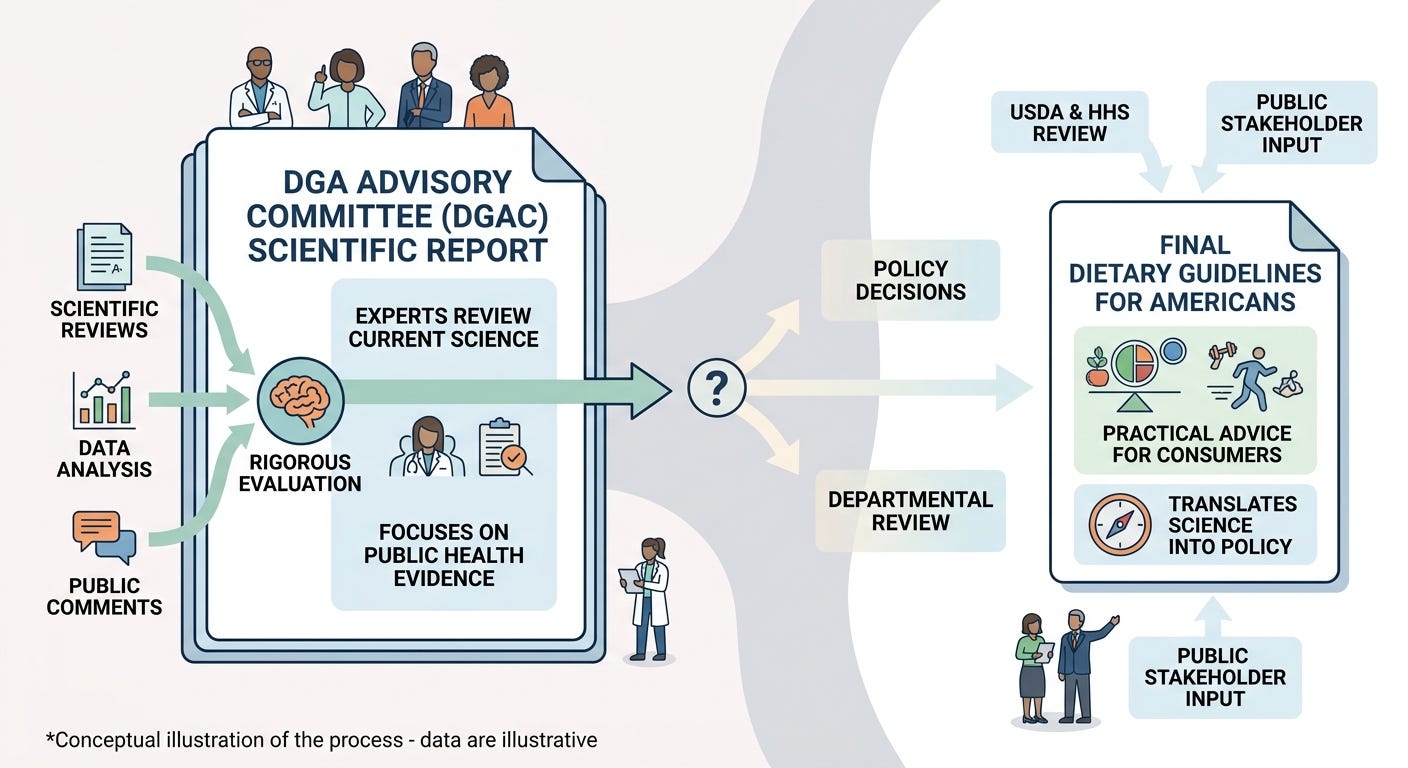
The 2025–2030 Dietary Guidelines for Americans arrived in early 2026 carrying something unusual: a meaningful departure from the process that normally produces them. The Dietary Guidelines Advisory Committee, an independent scientific panel that spends two years reviewing the peer-reviewed literature before each cycle, submitted its report. The federal departments then wrote guidelines that diverged from that report. Several major professional medical organizations, including the American College of Cardiology, weighed in publicly and critically within weeks of publication.
This is an evaluation of the science: an honest accounting of what both documents got right, what they got wrong, and what the gap between them tells you about the current state of nutrition science and policy in the United States.
Why These Guidelines Affect You Even If You Never Read Them
They are the foundational policy document for what is served in every school lunch program in the country, how the military feeds its personnel, how federal nutrition assistance programs are structured, and what public health education campaigns tell Americans about food.
The Advisory Committee report and the final published guidelines are two different documents produced by two different processes. The committee report is the scientific foundation: technically rigorous, academically cautious, and explicit about the strength and limitations of the evidence it reviews. The final guidelines are the policy document.
Where Both Documents Agree
Both documents agree on limiting added sugars, limiting sodium, limiting alcohol, prioritizing vegetables, fruits, and whole grains, and emphasizing whole foods over ultra-processed foods.
What the Guidelines Got Right
If you enjoy evidence-based medical information, subscribe to receive these articles delivered to your mailbox every week.
Ultra-processed Food An Overdue Reckoning
For the first time in the history of federal dietary guidance, the 2025–2030 guidelines name ultra-processed food directly and unambiguously as something to limit.
The Advisory Committee reviewed the evidence carefully. Its relative caution on this question serve the science better than it serves the people the science is meant to protect. A large nationally representative study with a median eight-year follow-up found that consumption of highly processed foods was associated with higher all-cause mortality even after adjusting for overall diet quality scores suggesting that existing dietary guidelines had not fully captured the harm.
Protein Targets Finally Calibrated to the Right Population
The 2025–2030 guidelines elevate protein recommendations to 1.2–1.6 grams per kilogram of body weight per day, a meaningful upward revision from the longstanding reference daily intake of 0.8 g/kg.
The 0.8 g/kg figure was established from nitrogen balance studies conducted primarily in young adults. It was never designed as an optimal intake target for aging or metabolically compromised populations. For middle-aged and older adults, the population at highest metabolic risk, the evidence consistently supports higher intake. The PROT-AGE Study Group, convened by the European Union Geriatric Medicine Society, recommends 1.0–1.2 g/kg daily for healthy older adults and 1.2–1.5 g/kg for those with acute or chronic illness. The ESPEN Expert Group similarly recommends a minimum of 1.0–1.2 g/kg for healthy older adults, with higher targets for those who are ill or malnourished. A 2025 randomized controlled trial published in Frontiers in Nutrition found that 1.2 g/kg daily was significantly more effective than 0.8 g/kg in preserving muscle mass, improving strength, and reducing abdominal adiposity in elderly women with sarcopenia over twelve weeks.
Sarcopenia, the progressive loss of muscle mass and function with age, is under recognized, under diagnosed, and under treated. It is also one of the most consequential drivers of metabolic deterioration in older adults, also affecting many on GLP-1 treatments targeting obesity.
What the Guidelines Got Wrong
The Saturated Fat Contradiction
The 2025–2030 guidelines retain the evidence-based limit of less than 10% of daily calories from saturated fat, approximately 22 grams on a standard 2,000-calorie diet. In the same document, they recommend three daily servings of full-fat dairy, over-promote red meat consumption, and list butter and beef tallow as acceptable fat sources.
The arithmetic does not work. As Harvard T.H. Chan School of Public Health analysis from January 2026 makes clear, three servings of full-fat dairy alone consume approximately 17 grams of saturated fat leaving roughly 5 grams of daily headroom before a single serving of the red meat as promoted in the document is consumed. This internal incoherence can lead to confusion and potential harm for those strictly adhering to these guidelines.
Eggs, unprocessed meat, and dairy have a place as part of a whole-food dietary pattern. So do plant-based sources of protein and fats such as leafy vegetables, legumes and whole grains. The balance between the two is what makes the saturated fat arithmetic manageable. It is also what the evidence actually supports: not animal protein exclusivity, not plant protein exclusivity, but a whole-food pattern that draws meaningfully from both.
The Fiber Omission
Approximately 94% of Americans fail to meet recommended fiber intake (approximately 25-35 grams daily), according to USDA dietary intake data and the 2025 DGAC Scientific Report. It is the most consistent and consequential nutritional failure in the American diet.
Fiber drives satiety through intestinal bulk. It slows glucose absorption and blunts the postprandial insulin spike that follows a carbohydrate load. It supports gut microbiome diversity in ways that are increasingly linked to metabolic and cardiovascular health. It reduces cardiovascular risk through multiple independent mechanisms. The guidelines’ relative silence on fiber is the most significant missed public health opportunity in the document.
The Protein Source Hierarchy
The guidelines list animal protein sources first within the protein food group, with plant sources positioned as secondary alternatives. The Advisory Committee’s recommendation moved in the opposite direction, toward plant-forward protein patterns, based on cardiovascular outcome data. As the American College of Cardiology’s Nutrition and Lifestyle Work Group noted in January 2026, this hierarchy, animal sources first, conflicts with the evidence on cardiovascular outcomes.
The relevant scientific axis here is not animal versus plant, it is whole food versus industrially processed food. Both animal and plant protein and fats in whole foods belong in a balanced dietary pattern. The guidelines’ implicit animal over plant source hierarchy sends a message science and cardiovascular evidence actively contradicts.
The Deeper Problem And What Comes Next
The failures described above are real. But they are also failures within a shared framework. That framework is nutrient arithmetic, the idea that what matters most about a diet is the accounting of its component parts: saturated fat grams, protein targets, fiber thresholds, added sugar percentages.
That framework captures something but misses something more important: food is a system, and the metabolic effect of what you eat is determined by the integrity of the whole not the sum of its nutrients.
A diet system is not only comprised to the nutrients it contains. The matrix, sequence, and pace matters as much. None of that appears in the 2025–2030 guidelines, or in the DGAC report, or in the critical response to either.
That is the subject of Part 2.
Action Steps: What to Take From This
1. Make ultra-processed food the primary target. Not just fat, carbohydrates or protein. The single most consequential dietary shift most Americans can make today is reducing ultra-processed food consumption.
2. Audit your protein intake, especially at breakfast. If you are over 50, the updated protein targets are appropriate for you. Aim for 1.2 g/kg of your body weight daily, distributed across meals. A 70 kg adult needs roughly 85 grams per day and the research suggests that many older adults fall short specifically at breakfast, the meal that matters most for muscle protein synthesis over the course of the day.
3. Balance animal and plant protein sources. Not because animal foods are harmful, but because the balance is what makes both the saturated fat arithmetic and the cardiovascular evidence work in your favor.
4. Prioritize fiber deliberately. Aim for at least 25–35 grams of fiber daily from whole food sources: vegetables, legumes, whole grains, fruit. This is where the guidelines failed, redress this failure on your own.
5. Read labels for what they don’t tell you. A food with a favorable nutrient profile on the label can still be ultra-processed. The ingredient list tells you more about a food’s metabolic impact than any single nutrient figure.
6. Limit sodium while increasing potassium intake. Limiting sodium is a good recommendation, but studies increasingly point to the beneficial effects of potassium on blood pressure control. Keep in mind over 70% of dietary sodium in the American diet comes from packaged and prepared foods, not from table salt added during cooking or eating. Yet another reason to limit ultra-processed food consumption.
Found this article useful? Share your thoughts. Join the conversation below.
Educational content on The Metabolic Archives is free, because medical information should be accessible to everyone. If you find value and want to support the work, a paid subscription is available and genuinely appreciated. Visit the About Page for additional information.
Disclaimer: The information provided in The Metabolic Archives is for educational and informational purposes only, and is not intended as medical advice, diagnosis, or treatment, and does not constitute a doctor-patient relationship. Do not adopt any recommendation discussed in any article or guides published here, make changes or abandon any prescribed medical treatment without prior consultation with your physician. Always seek the advice of your physician or other qualified health provider for any questions regarding your medical condition and recommended treatment options.
By reading this post, you acknowledge that you have read and agree to the Terms of Service of The Metabolic Archives, which govern all use of this content including restrictions on reproduction.
© 2026 The Metabolic Archives. All rights reserved.
This term ‘Ultra Processed Food’ ( UPF) is a zombie term. There is some reality in the concerns about it, but honestly most shoppers cannot clearly figure out what is an UPF. And it is not that they don’t carry any nutritional value. Those who gave these guidelines must also clearly explain what is what. Is a packet of dry pasta an UPF ? It is basically a convenience food, a reconstitutable food. For a start, let these people list out some top 25 very popular packaged foods from supermarket shelves that can be labelled as an UPF. If the worry is about the additives, let it be widely known to the public. They can even be on display as an information source in front of the stores. So that people can take their own decisions.
Is it OK to post links to your articles on X or Truth Social?