
The Truth About Fad Diets and Weight Loss Products
A plain-language guide to what works, what doesn't, and what can hurt you


The weight loss industry generates between $20 and $33 billion annually in the United States. It has done so for decades, yet obesity rates have climbed throughout. If any of this were working at the population level, the numbers would look different.
That gap between what the industry spends and what it produces is not an accident. The industry sells solutions that do not produce lasting results to people who will blame themselves when they fail, and return to try again. The science tells a different story one that starts not with the diet, but with the biology underneath it.
Why Every Diet Fights the Same Opponent
When you lose weight through caloric restriction your body does not cooperate passively, it adapts. Resting energy expenditure decreases, you burn fewer calories at rest than you did before losing the weight. Appetite hormones shift to increase hunger and reduce the sensation of fullness.
According to Fischer, Oberänder, and Weimann (2020), weight loss in behavioral interventions typically peaks at around six months, after which plateau and progressive regain follow. Participants typically regain 30–35% of lost weight in the first year after an intervention ends, and most return to baseline weight within three to five years regardless of which diet they followed. Sukkar and Muscaritoli (2021) documented the same hormonal and metabolic adaptations across dietary approaches, confirming that the mechanism is not specific to any one diet.
The Diet Tier, A Spectrum from Overstated to Incoherent
Atkins and Ketogenic Diets
Atkins is the predecessor of modern low-carbohydrate. The diet works in the short term through a legitimate mechanism. Severe carbohydrate restriction forces the body into ketosis, shifting its primary fuel source from glucose to fat. After an initial phase of ketosis, Atkins allows for gradual reintroduction of enough carbohydrates to end ketosis becoming a low-carbohydrate diet. True ketogenic diets aim at maintaining ketosis indefinitely by severe carbohydrate restrictions, and limiting protein as well which Atkins does not.
The problems are sustainability and the long-term evidence gap. Keating et al. (2024) document the common side effects: gastrointestinal disturbance, fatigue, dizziness, and mood changes. Longer-term concerns include dyslipidemia and kidney stone risk. Sukkar and Muscaritoli (2021) note that long-term safety remains inadequately studied. A systematic review and meta-analysis by Naude et al. (2014) found that low-carbohydrate diets show no meaningful advantage over isoenergetic balanced diets for long-term weight loss or cardiovascular risk reduction.
Paleolithic Diet
The ancestral eating premise rests on shaky anthropological ground. Hunter-gatherer diets varied enormously by geography and season; there is no single paleolithic template. Tahreem et al. (2022) found no evidence that paleolithic dietary patterns produce superior weight loss outcomes compared to other caloric restriction approaches, and long-term adherence data is poor. The weight loss appears to be a function of caloric restriction rather than anything specific to the dietary composition.
Detox Cleanses
The liver and kidneys are the body’s detoxification systems. They do not require supplemental assistance from a juice cleanse or herbal product. No detox product on the market has identified which specific toxins it removes, through which biological mechanism, or in what quantity. Available scientific reviews, including Badley and Lein (2024), consistently find that the claimed health benefits are not supported by evidence, and any transient effects do not constitute detoxification.

If you enjoy evidence-based medical information, subscribe to receive these articles delivered to your mailbox every week.
Intermittent Fasting, A Different Category
Intermittent fasting, and specifically time-restricted eating protocols like 16:8, is not a fad diet. It belongs in a different category because its mechanistic rationale is legitimate and its evidence base is stronger than diets discussed above.
Sousa and Almeida (2024) document modest improvements in metabolic markers associated with time-restricted eating protocols. Sukkar and Muscaritoli (2021) confirm the mechanistic plausibility while noting that long-term data remains limited and weight recovery after fasting periods ends is frequently observed.
What intermittent fasting cannot do is deliver the dramatic metabolic transformation that social media claims it can. Weight loss outcomes are modest. The long-term evidence is still developing.
The Product Tier, Where the Stakes Rise
Under the Dietary Supplement Health and Education Act of 1994 (DSHEA), supplement manufacturers are not required to demonstrate safety or efficacy before bringing products to market. The FDA does not review or approve these products before they reach store shelves. There are no credible studies on efficacy, safety, or potential interactions with medications for many of these products before they reach the market.
The research record on OTC weight loss supplements confirms this. Manore and Patton-López (2022) reviewed the clinical evidence and found consistent results: little efficacy and potentially serious risk of harm. Of commonly studied ingredients, only caffeine and green tea have any data supporting a modest effect on fat metabolism.
The Documented Harm Record
Hydroxycut: The FDA issued a public warning and recall in 2009 following reports of serious liver injuries, including at least one death. Multiple product reformulations have followed. Fong et al. (2010) documented the case series in peer-reviewed literature.
OxyElite Pro: In 2013, this product was associated with an outbreak of acute liver injury in Hawaii: 97 reported cases, multiple hospitalizations, at least one death, and at least one liver transplant. The FDA issued a warning, the manufacturer voluntarily recalled the product. Federal criminal prosecution of the manufacturer followed.
Criminal Adulteration
Some weight loss supplements do not merely fail to work. They contain undisclosed pharmaceutical drugs, substances withdrawn from the US market because they caused documented harm.
Zhivikj et al. (2024) and Manore and Patton-López (2022) document the adulteration of weight loss supplements with sibutramine, a cardiovascular drug withdrawn from the US market in 2010 due to increased risk of heart attack and stroke, and with fenfluramine, withdrawn in 1997 after causing cardiac valve damage and pulmonary hypertension. A consumer purchasing what the label describes as a herbal supplement may be ingesting a potentially dangerous pharmaceutical agent without knowing it.
The GLP-1 Supplement Frontier
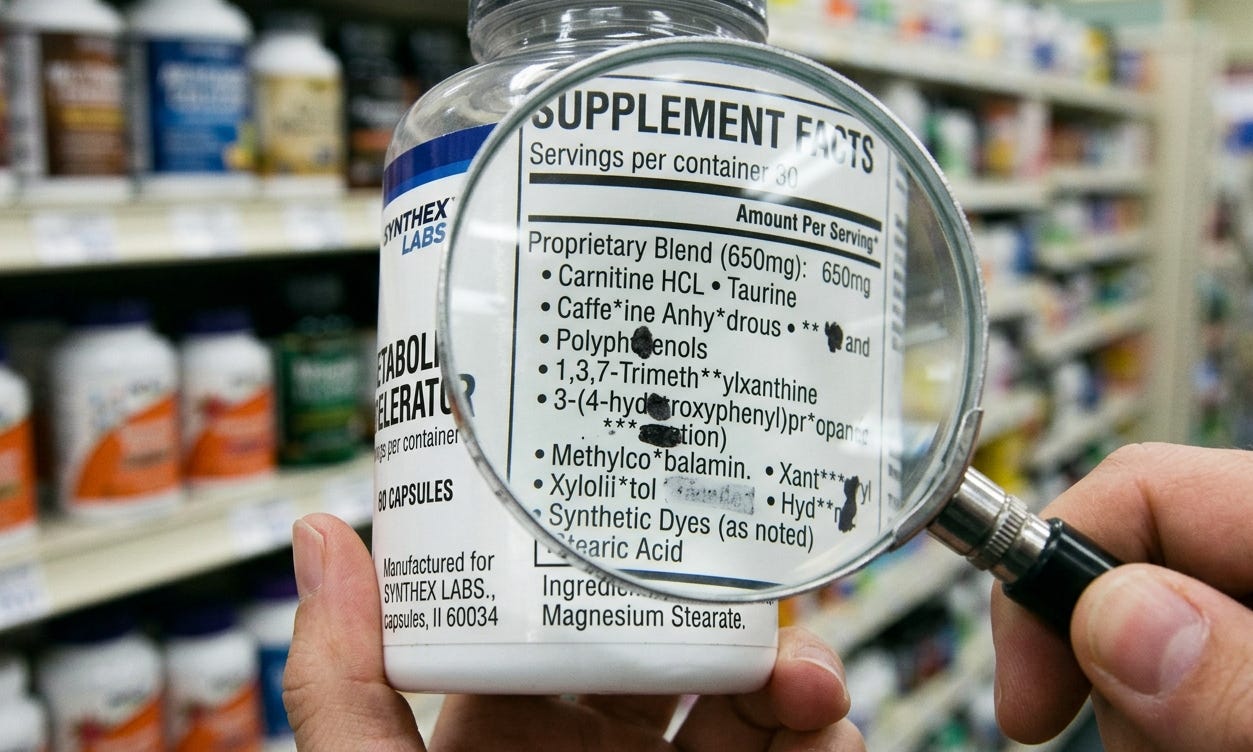
Following the cultural visibility of prescription GLP-1 medications a category of supplements has emerged claiming to replicate or boost GLP-1 activity through ingredients including berberine, green tea extract, and taurine. These claims are not supported by evidence.
The FDA issued warning letters in December 2024 to products making drug-like GLP-1 claims, including Veronvy (FDA, 2024). The FTC took enforcement action against NextMed and issued a Final Order in December 2025 for deceptive GLP-1 program advertising, including fabricated testimonials and undisclosed costs.
These supplements bear no meaningful relationship to the medications whose names and mechanisms they invoke.
How to Recognize Fraud
The Federal Trade Commission publishes a plain-language guide called Gut Check: A Reference Guide for Media on Spotting False Weight-Loss Claims, a practical tool that identifies claims government-engaged scientists have determined are simply not possible. Any product making these claims is, by FTC definition, making a claim known to be false:
Causes weight loss of two pounds or more per week without dieting or exercise.
Causes substantial weight loss no matter what you eat.
Causes permanent weight loss even after you stop using the product.
Blocks the absorption of fat or calories to cause substantial weight loss.
Safely enables users to lose more than three pounds per week for more than four weeks.
Causes substantial weight loss for all users.
Causes substantial weight loss by wearing it on the body or rubbing it into the skin.
The next time you see a weight loss advertisement, run it against these criteria. Ethan et al. (2016) found that 40% of weight loss advertisements in mainstream media were false or misleading.
What the Evidence Actually Supports
A large-scale social media analysis by Yom-Tov and Hochberg (2022) found that the average person seeking to lose weight aims to lose 24–37 kg, while clinical trial results show actual loss of 4–7 kg, with long-term maintained loss averaging 3.1 kg.
What the evidence does support for sustainable weight management: modest, consistent changes to dietary patterns sustained over time; regular physical activity; adequate sleep; and management of the psychological dimensions of eating behavior. While they will never generate $20 billion in revenue, they produce meaningful durable health benefit without the risks documented above.
Found this article useful? Share your thoughts. Join the conversation below.
Educational content on The Metabolic Archives is free, because medical information should be accessible to everyone. If you find value and want to support the work, a paid subscription is available and genuinely appreciated. Visit the About Page for additional information.
Disclaimer: The information provided in The Metabolic Archives is for educational and informational purposes only, and is not intended as medical advice, diagnosis, or treatment, and does not constitute a doctor-patient relationship. Do not adopt any recommendation discussed in any article or guides published here, make changes or abandon any prescribed medical treatment without prior consultation with your physician. Always seek the advice of your physician or other qualified health provider for any questions regarding your medical condition and recommended treatment options.
By reading this post, you acknowledge that you have read and agree to the Terms of Service of The Metabolic Archives, which govern all use of this content including restrictions on reproduction.
© 2026 The Metabolic Archives. All rights reserved.