
What the Science Actually Says About Cookware and Health
An evidence-based guide for the health-conscious home cook

You’ve committed to cooking more of your own food, good for you! But the moment you walk into the kitchen you wonder: what am I cooking with?
The surfaces food contacts during preparation and cooking interacts with heat, acidity, and time. Almost none of them are as alarming as the internet would have you believe, or as harmless as the cookware industry would prefer.
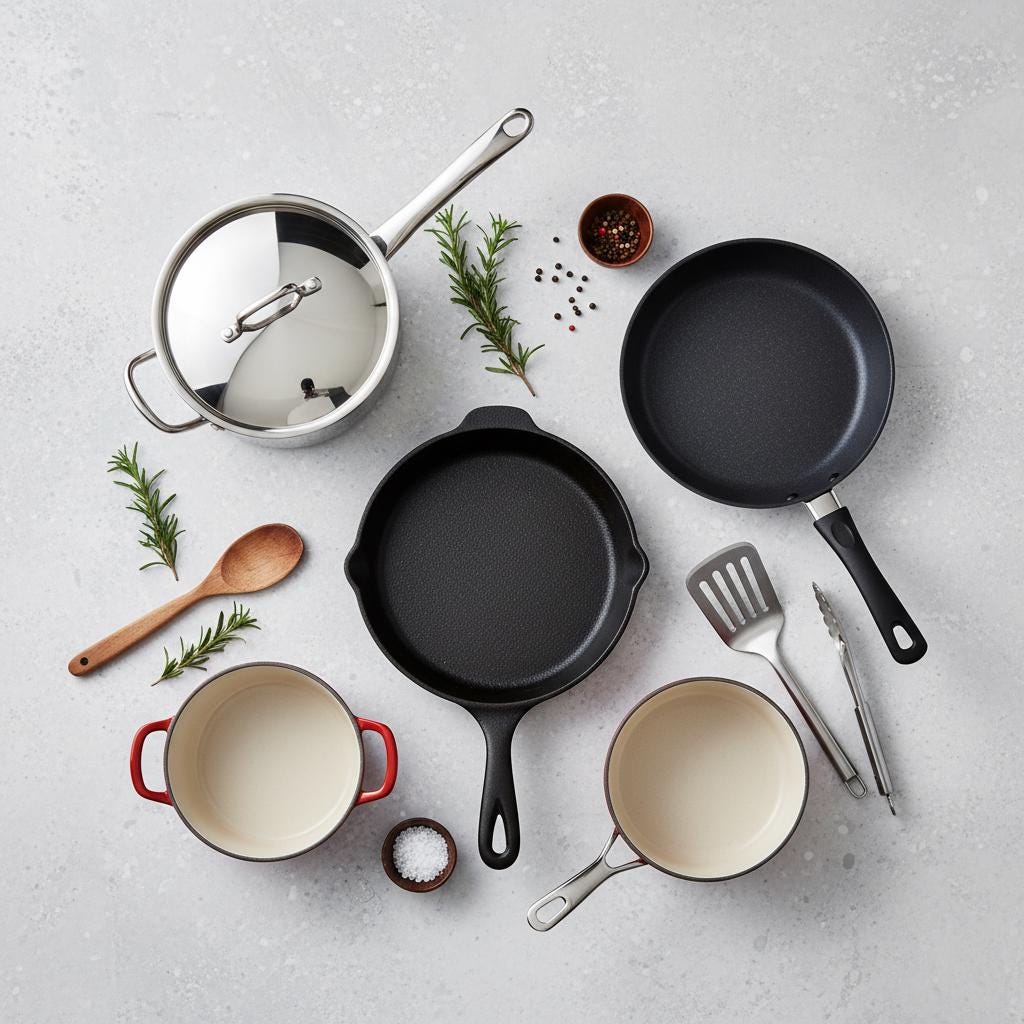
Non-Stick Pans
PTFE (polytetrafluoroethylene) is the non-stick polymer itself, the slick surface that makes eggs slide. PFOA (perfluorooctanoic acid) is a different chemical agent used in the manufacture of PTFE coatings, and the source of the documented population-level harm. PFOA was phased out of US manufacturing by 2013.
A large observational cohort of approximately 150,000 people in northern Italy exposed to polyfluoroalkyl substances (PFAS)-contaminated water between 1980 and 2018 showed elevated cardiovascular mortality and increased rates of kidney and testicular cancer. A nested case-control study in US Air Force men found a positive association between serum PFAS concentrations and testicular germ cell tumor risk (Dich et al., Environmental Health Perspectives, July 2023). A broader review links PFAS exposure to liver disease, thyroid dysfunction, impaired vaccine response, reduced fertility, and hypertension in pregnancy (Fenton SE et al., The Lancet Planetary Health, 2023, PMC10505820). PFOA has been classified as a possible human carcinogen by the International Agency for Research on Cancer.
PTFE begins releasing decomposition products above approximately 260°C (500°F). At extreme temperatures above 350°C, documented toxic fume release occurs, polymer fume fever in humans, and lethal toxicity in birds. A 2024 study examining aluminum cookware coated in PTFE-based and granite-style coatings found that prolonged heating above 250°C altered internal coating structures affecting release potential.
Direct product testing by the Ecology Center found that 79% of non-stick cookware contains PTFE coatings, and that “PFOA-free” labeling does not mean PFAS-free: PTFE is itself a member of the PFAS chemical family. Consumer Reports investigation (October 2022) found PFOA detectable in products claiming PFOA-free status due to manufacturing residues. The label that carries real meaning is PTFE-free.
Non-stick cookware is safe to use when you follow these three simple rules: never use at high heat, never use metal utensils, and replace when the coating shows visible damage.
Ceramic-Coated Cookware
The coating on ceramic-coated cookware is not fired clay or porcelain. It is primarily silicon dioxide, sand-derived, applied through a sol-gel manufacturing process and considered safe by toxicologists. These have no PFAS chemicals.
Consumer and laboratory testing has detected titanium dioxide (TiO2) and silicon dioxide (SiO2) nanoparticle migration from ceramic-coated cookware, particularly under abrasion conditions. High titanium levels were found in testing of GreenPan, Always Pan, and Caraway products (Bott J et al., Food Control, 2014, DOI: 10.1016/j.foodcont.2013.07.014). The EU has banned TiO2 as a food additive. The health implications of ingested nanoparticles from cookware remain under active investigation as of 2026.
The widely reported 1-3 year lifespan for ceramic-coated cookware reflects typical consumer handling. With correct handling (non-metal utensils, gentle cleaning, hand washing), ceramic-coated cookware can maintain its integrity for years. Visibly scratched or chipped coating is the signal to replace.
If you enjoy evidence-based medical information, subscribe to receive these articles delivered to your mailbox every week.
The Plastic Problem
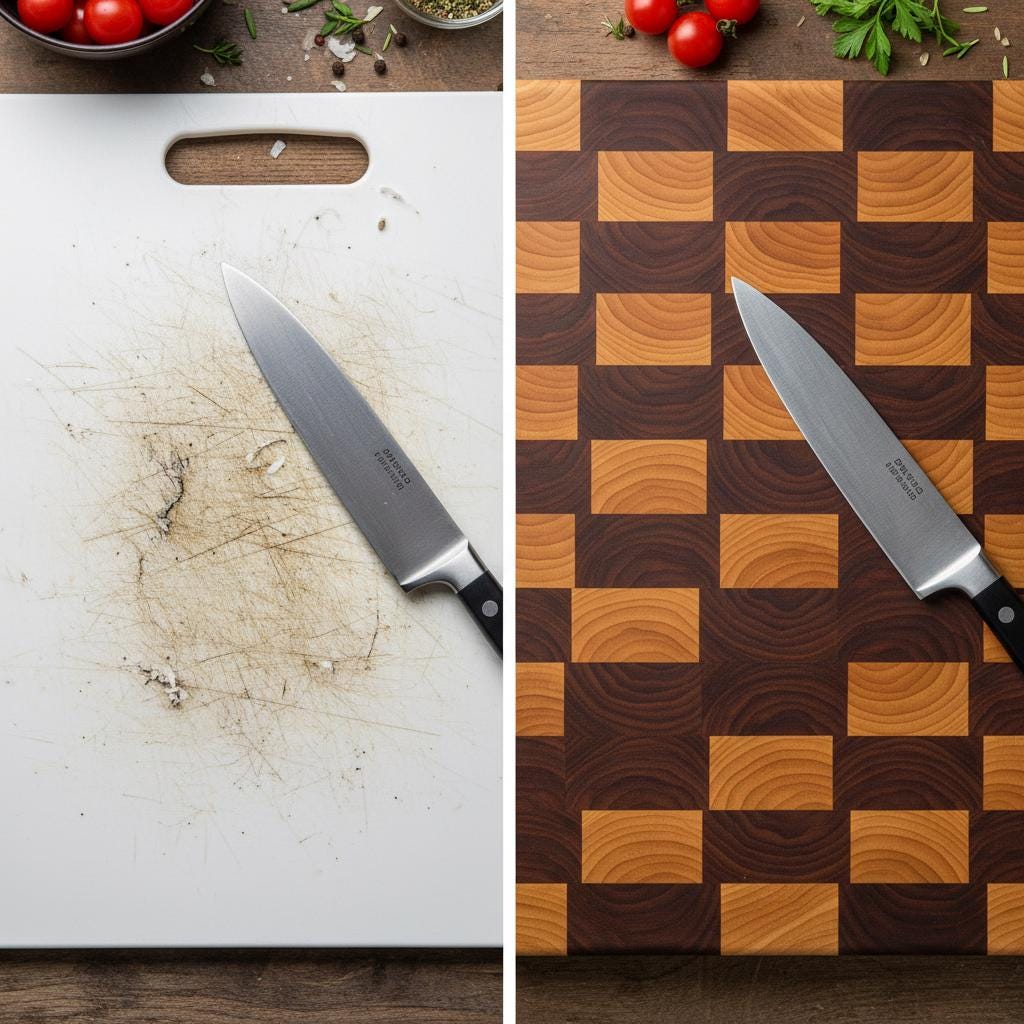
Cutting boards. Routine knife work on polypropylene and polyethylene cutting boards releases measurable quantities of microplastic particles into food. A controlled laboratory study by Hussain KA et al. (Environmental Science & Technology, 2023, 57(22):8225-8235) found that a single knife stroke releases an estimated 100-300 microplastic particles, with approximately 50% of released particles transferring to food rather than remaining on the board surface. Polypropylene boards released 5-60% more microplastic mass than polyethylene boards. Annual exposure from regular use is projected in the millions of particles. A systematic review in the Journal of the Academy of Nutrition and Dietetics (October 2025, DOI: 10.1016/S2212-2672(25)00435-6) confirmed these findings across peer-reviewed literature from 2016-2024.
Health implications of ingested microplastics remain under active investigation, but there is good case to be made for switching to safer wood or end-grain hardwood cutting boards.
Plastic containers and reheating. Heating food in plastic containers accelerates leaching of endocrine-disrupting compounds into food. Containers labeled BPA-free, particularly those containing BPS, carry The alternative is using glass or ceramic containers for reheating.
Styrene migration from heating food in Styrofoam containers is well documented. Styrofoam is never appropriate for reheating.
On Wooden Cutting Boards
Wooden boards require regular cleaning and periodic oiling to prevent cracking, bacterial harborage in deep cuts, and warping. End-grain hardwood is the gold standard, is knife-friendly, self-healing to a degree, and durable with proper care. Bamboo is harder than most wood, which makes it somewhat less forgiving on knife edges.
The Reliable Workhorses
Stainless steel is broadly safe, with one caveat. Nickel and chromium leaching into food from stainless steel cookware is real and documented. A controlled study by Kamerud KL et al. (Journal of Agricultural and Food Chemistry, 2013, 61(39):9495-9501, PMC4284091) found that after 6 hours of cooking tomato sauce in stainless steel, nickel concentrations increased up to 26-fold and chromium up to 7-fold versus baseline. Leaching is highest from new pans and stabilizes after approximately 6 cooking cycles; by the 10th cycle, 88 µg nickel and 86 µg chromium per serving were still detected.
These amounts remain below established harm thresholds for most people. For individuals with known nickel sensitivity or allergy, stainless steel is a dietary nickel source worth considering.
Cast iron and carbon steel both leach iron into food, and for most people this is either neutral or beneficial, particularly when cooking acidic foods. Well-seasoned cookware reduces leaching substantially. For people with hemochromatosis, cumulative iron loading from cookware is a problem and should be avoided.
Carbon steel pans behaves identically to cast iron, can be used interchangeably for any cast iron application while being significantly lighter and easier to handle. They carry the same caution regarding iron leeching, perhaps even more than cast iron.
Enameled cast iron is the cleanest all-purpose option in this category. The enamel layer eliminates direct iron leaching, is chemically inert, carries no coating chemistry concerns, and is durable enough to last a lifetime with reasonable care.
What About Silicone
Silicone is better than plastic but not as safe as stainless steel. Cyclic siloxanes (D4, D5, D6) are released from silicone bakeware during high-temperature use and have been associated with potential endocrine disruption, reproductive effects, and liver toxicity in some studies (Science of the Total Environment, 2023, 858:159697; PubMed PMID: 40876430, October 2025). Health Canada’s 2023 assessment concluded that siloxanes at current exposure levels are not harmful, and the regulatory consensus supports food-grade silicone within recommended temperature limits. Chemical migration decreases approximately 95% after the first few baking cycles, which means new items carry the highest off-gassing potential.
Aluminum and Renal Disease
Aluminum leaching from uncoated cookware into acidic foods is real and documented. For the general population the potential aluminum load is manageable, and anodized aluminum substantially reduces it. The Alzheimer’s association is a long-standing controversy that the current evidence does not support as a meaningful risk from cookware use. Both the Alzheimer’s Association and Alzheimer’s Research UK hold this position explicitly (Alzheimer’s Research UK position statement, updated August 2024).
The population-specific exception is patients with chronic kidney disease (CKD) and those on dialysis. StatPearls/NCBI Bookshelf (Aluminum Toxicity, NBK609094, updated October 2024) explicitly identifies aluminum cookware as a recognized exposure source and recommends avoidance in patients with impaired renal function. A case-control study of maintenance hemodialysis patients found a striking association: 100% of chronic aluminum toxicity cases had a history of aluminum utensil use, compared to 14.3% of controls, with a relative risk of 28.46 (95% CI: 1.81-445.3) (Gupta YK et al., National Medical Journal of India, 2019, PMID: 31309799).
Regarding Cooking Utensils
Metal utensils are appropriate for uncoated cookware only: stainless steel, cast iron, carbon steel, enameled cast iron. They are not appropriate for any coated cookware as they can damage the coating.
Silicone utensils and wooden utensils are excellent for all types of cookware.
An Informed Kitchen, Not a Perfect One
The goal here is to provide a working understanding of which materials carry conditional risks, which populations need to apply additional care, and which alternatives are supported by the evidence.
Found this article useful? Share your thoughts. Join the conversation below.
Educational content on The Metabolic Archives is free, because medical information should be accessible to everyone. If you find value and want to support the work, a paid subscription is available and genuinely appreciated. Visit the About Page for additional information.
The Metabolic Archives is for educational and informational purposes only, and is not intended as medical advice, diagnosis, or treatment, and does not constitute a doctor-patient relationship. Do not adopt any recommendation discussed in any article or guides published here, make changes or abandon any prescribed medical treatment without prior consultation with your physician. Always seek the advice of your physician or other qualified health provider for any questions regarding your medical condition and recommended treatment options.
By reading this post, you acknowledge that you have read and agree to the Terms of Service of The Metabolic Archives, which govern all use of this content including restrictions on reproduction.
© 2026 The Metabolic Archives. All rights reserved.
Wow. Didn't know stainless steel released nickel!! I'm allergic to that! Been using for over 50 years! Say "after approximately 6 cooking cycles; by the 10th cycle, 88 µg nickel and 86 µg chromium per serving were still detected." Think they go away after 20, 30, 40 years or more??