
What’s Wrong with Medicine Today: My Perspective After Forty Years in the System
Pay No Attention To That Man Behind The Curtain / Part Seven

OPINION PIECE
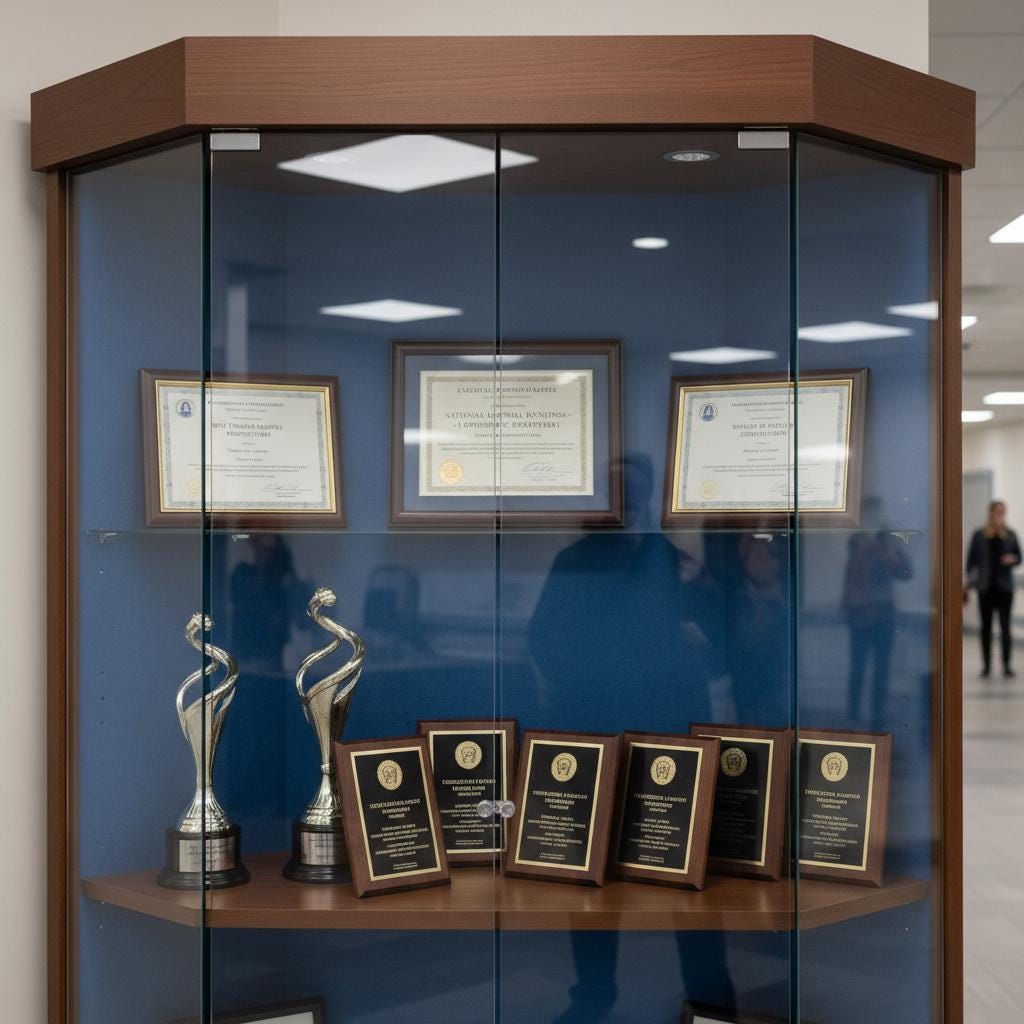
You walk into the hospital lobby and see it behind the counter: America’s Top 100 Hospital for Cardiac Care. A warm sense of reassurance fills you up knowing this is the right hospital for your mother’s cardiac event. You head to the elevators leaving any lingering doubts behind.

The Accreditation Industry: Scale and Structure
The Joint Commission is the dominant accrediting body in American healthcare. It accredits approximately 80% of the nation’s hospitals and accredits or certifies more than 22,000 healthcare organizations and programs in total (The Joint Commission, jointcommission.org). A majority of state governments recognize Joint Commission accreditation as a condition of licensure for Medicare and Medicaid reimbursement.
Hospitals pay the Joint Commission approximately $37,000 to $46,000 annually to maintain accreditation status, plus separate survey fees during inspection years. The Joint Commission’s accreditation division reported $164 million in revenue in 2016. It is a not-for-profit organization in legal structure. In economic function, it operates as a mandatory vendor to an industry that cannot afford to lose its product (GAO-07-79, 2007).
The Inspection Process: Policy and Practice
The Joint Commission’s official position is that hospitals receive no advance notice of survey dates. Surveys have been formally designated as unannounced since January 1, 2006, following sustained public criticism of the prior practice of notifying hospitals in advance. A 2005 Washington Post investigation found that approximately 99% of inspected hospitals were accredited, and that serious problems in care delivery were sometimes overlooked or missed. The Boston Globe documented that the Joint Commission’s governing board had long been dominated by representatives of the industries it inspects, an observation the organization has never disputed.
The Joint Commission publishes a comprehensive Survey Activity Guide that outlines in precise detail what surveyors will examine. Surveys occur within a known 18-to-39-month window following the previous survey. The practical result is an institutional preparation culture: policies get reviewed, signage gets updated documentation backlogs get addressed, staff get reminded of procedures they are expected to demonstrate. The period before a Joint Commission survey has a specific texture in hospital practice that differs from the period after one.
During my years in practice at times I was explicitly informed, weeks before a scheduled Joint Commission survey, that specific patient charts were selected for inspector review and documentation on those charts required attention before the survey took place. I offer this as my own experience, not as institutional policy. I leave the gap between those two things for the reader to assess.
What the Evidence Says About Accreditation and Patient Outcomes
A 2018 observational study published in the BMJ examined more than 4.2 million Medicare patients admitted to 4,400 hospitals between 2014 and 2017 (Lam MB et al., BMJ, 2018). The findings: no significant difference in risk-adjusted 30-day mortality or readmission rates between Joint Commission-accredited hospitals and hospitals reviewed through state-based systems.
Another systematic review covering two decades of accreditation research found a trend toward positive associations between accreditation and clinical outcomes but characterized the methodological quality of included studies as variable and the evidence as insufficient for definitive conclusions (Brubakk K et al., BMC Health Services Research, 2015). A 2025 systematic review of Joint Commission International accreditation concluded that whether accreditation adds genuine value “remains unclear” (PLOS One, 2025).
What accreditation does appear to improve consistently is process compliance and documentation quality. A 2018 cross-sectional study examining the evidence base for Joint Commission standards found that a substantial proportion of accreditation requirements were supported by low-quality evidence, expert opinion and case reports rather than controlled trials (Hatcher JH et al., BMJ Open, 2018).
If you enjoy evidence-based medical information, subscribe to receive these articles delivered to your mailbox every week.
The Conflict at the Center
The Joint Commission operates a consulting subsidiary called Joint Commission Resources, which reported $63.5 million in revenue in 2016. Joint Commission Resources sells preparation services, educational materials, and consulting support to healthcare organizations, many of which are also accreditation clients of the Joint Commission itself. The organization maintains formal firewall policies prohibiting shared information between its accreditation and consulting arms.

The Centers for Medicare and Medicaid Services found the concern serious enough to open a formal inquiry and solicit public comment on whether accrediting organizations providing fee-based consulting to the facilities they accredit constitutes a conflict of interest (Modern Healthcare, December 2018).
That inquiry produced no formal regulatory action, the business arrangement remains in place.
Board Certification: The Original Promise and What It Became
The American Board of Medical Specialties, founded in 1933, built a credentialing system around a premise: a standardized examination to establish that physicians achieved a minimum level of knowledge in their field. A systematic review of studies from 1966 to 1999 found that 16 of 29 analyses showed a statistically significant positive association between board certification and better clinical outcomes but 13 did not (Tamblyn R et al., Academic Medicine, 2002).
The Maintenance of Certification program was introduced in 2000 and expanded in 2014. MOC requires board-certified physicians to pay for additional ongoing testing, and practice improvement activities to maintain their certification or potentially loss hospital privileges and insurance panel participation in many systems. The ABMS currently certifies approximately 989,000 physicians. Combined revenue across its 24 member boards is estimated at $350 million annually (Coronis Health, 2020; Medical Economics, 2024).
A published financial analysis confirmed that the majority of member boards increased revenue substantially following MOC implementation (Hawkins RE et al., Journal of Continuing Education in the Health Professions, 2015). The American Board of Anesthesiology stated publicly in 2011 that MOC requirements “will not have a sufficient impact on patient care.” No high-quality evidence has since established that MOC participation improves patient outcomes.
Antitrust litigation has been filed against multiple ABMS member boards by the Practicing Physicians of America, alleging that tying MOC to initial board certification and hospital credentialing violates federal antitrust law. The Pennsylvania Medical Society adopted a formal vote of no confidence against the American Board of Internal Medicine in 2016. Surveys of practicing physicians consistently find that the majority view MOC as financially motivated, marginally relevant to daily practice, and a significant driver of burnout and early retirement.
Hospital Rankings: The Mathematics of the Lobby Wall
The US News Best Hospitals rankings evaluate more than 4,500 hospitals annually across 16 specialty categories, plus state rankings, metro rankings, best children’s hospital rankings, and procedure and condition ratings. The arithmetic of overlapping regional and specialty categories makes it structurally possible for a very large proportion of American hospitals to appear on some ranking in some category.
San Francisco City Attorney David Chiu formally demanded that US News disclose payments received from the hospitals it ranks including licensing fees for the Best Hospitals badge, subscriptions to its Hospital Data Insights platform, and advertising revenue from its rankings publications arguing that failure to disclose these financial relationships violated Federal Trade Commission regulations (Becker’s Hospital Review, 2023). US News acknowledges it receives revenue from hospitals it ranks, but maintains that this revenue does not influence rankings.
Penn Medicine’s University of Pennsylvania Health System withdrew from the rankings in 2023, with its CEO citing a methodology that focuses excessively on inpatient care, relies on Medicare data covering only patients 65 and older, and creates perverse incentives for hospitals to invest mostly in ranking categories. St. Luke’s University Health Network withdrew citing the use of subjective physician peer opinion surveys which function, as one health quality expert described it, as a popularity contest rife with economic and referral-relationship biases (Healthcare Finance News, 2023).
In some specialties, US News rankings are based entirely on peer opinion surveys. The organization has acknowledged this limitation and indicated its intention to phase out peer opinion as objective outcome data becomes available across more domains.
The “Top Physician” Industry: A Documented Racket
In 2019, ProPublica investigative journalist Marshall Allen received a solicitation for a Top Doctor award. He disclosed to the sales representative that he was not a physician but the award remained available. The customized plaque — cherrywood with gold trim or black with chrome — was offered at standard pricing (Allen M, ProPublica, 2019; Reader’s Digest, October 2019).
The Consumers’ Research Council of America’s Top Physicians database, as documented by ABC News, included a cardiologist convicted of manslaughter for administering a lethal propofol overdose to a patient, and a pediatrician convicted of molesting more than 100 children. Both remained listed as top physicians in their specialties (ABC News, 2012).
Cooper Health System issued a formal written warning to its physicians identifying specific soliciting organizations by name and instructing staff that any award offer requiring payment for a plaque or listing was likely a scam (Cooper Health System internal communication, 2018).
Some slightly better physician recognition programs use nomination-based processes with license and discipline verification. Castle Connolly’s co-founder acknowledged it would be “very difficult” to prevent gaming of the nomination process. Super Doctors explicitly disclaims that listed physicians are not necessarily better than non-listed physicians. They are still peer-reputation surveys with documented susceptibility to referral relationship and economic biases.
What the Certification Industry Gets Right
Baseline accreditation standards do maintain a process compliance floor that has genuine value. Hospitals operating below that floor are more dangerous. The requirement to maintain medication management systems, infection control protocols, and staff competency documentation produces real institutional discipline. The original board certification examination established a minimum knowledge standard that served a legitimate gatekeeping function. Some of the evidence on certification and clinical outcomes is positive.
The problem is that they have been marketed to patients making decisions about where to seek care and which physicians.
The better questions when evaluating a hospital or physician:
What are the documented complication rates for the specific procedure you need?
What is the volume of that procedure at this institution?
Is this physician in good standing with their state medical board?
These are publicly available through state licensing databases, CMS Hospital Compare, and the ABMS physician lookup tool. They are harder to find than a lobby poster. They are more informative.
Found this article useful? Share your thoughts. Join the conversation below.
Educational content on The Metabolic Archives is free, because medical information should be accessible to everyone. If you find value and want to support the work, a paid subscription is available and genuinely appreciated. Visit the About Page for additional information.
The Metabolic Archives is for educational and informational purposes only, and is not intended as medical advice, diagnosis, or treatment, and does not constitute a doctor-patient relationship. Do not adopt any recommendation discussed in any article or guides published here, make changes or abandon any prescribed medical treatment without prior consultation with your physician. Always seek the advice of your physician or other qualified health provider for any questions regarding your medical condition and recommended treatment options.
By reading this post, you acknowledge that you have read and agree to the Terms of Service of The Metabolic Archives, which govern all use of this content including restrictions on reproduction.
© 2026 The Metabolic Archives. All rights reserved.
Nicely done! The takeaway: the American Board of Medical Specialties is a politically captured, money printing machine which, in the modern era, has little to do with true quality of care by the physician members. Another takeaway: the oversight of The Joint Commission is mostly smoke and mirrors (as is virtually every oversight agency) which can be game-played by the institutions adept at playing games. And — where (or to whom) does all the money go??