You Don’t Need a Diet Plan
What the Mediterranean, DASH, and Volumetric diets teach us — and how to apply their principles to the food you already eat
You have probably experienced this more than once. January arrives, resolve is high. You commit to a specific diet plan. The first two weeks go well. By week four, something gives. By week eight, the plan is gone and the old habits are back.
The Real Reason Diets Don’t Stick
A 2020 digital epidemiological study published in PLOS ONE tracked real-world adherence to dietary plans using search and behavioral data across millions of users (Towers et al., PLOS ONE, 2020). Every major diet showed the same pattern: a sharp January spike, followed by rapid decline. Average compliance across popular dietary plans lasted approximately three to five weeks. In structured clinical intervention programs, where participants receive professional guidance, regular check-ins, and motivational support, dropout rates still exceed 40% within the first twelve months (Frontiers in Nutrition, 2022). Even in rigorous randomized controlled trials, participants tend to revert to prior eating habits once the study ends (McMahon et al., Nutrients, 2022).
Rigid externally designed meal plans built around unfamiliar foods require a complete behavioral overhaul layered on top of an already complex life. Most people cannot sustain that alongside work, family, budget constraints, and cultural food traditions.
The more productive question is not which diet should I follow this time? It is: what do these diets actually do, and can I do that with the food I already eat?
Three Diets, Three Principles
The three dietary systems below were extensively studied. Each works through a specific identifiable mechanism. And each mechanism can be applied to nearly any food culture, any budget, and any kitchen without wholesale adoption of the full dietary system.
The Mediterranean Diet, Fat Quality Principle
The Mediterranean dietary pattern emerged from epidemiological observations in the 1950s and 1960s noting that populations around the Mediterranean basin had substantially lower rates of cardiovascular disease than northern European and American populations despite diets that were high in fat. Decades of research have since traced much of that benefit to the type of fat consumed, not the amount.
Extra-virgin olive oil (EVOO) is the cornerstone. It is rich in oleic acid, a monounsaturated fatty acid, and contains bioactive polyphenols, including hydroxytyrosol and oleocanthal, that exert antioxidant, anti-inflammatory, vasodilatory, and lipid-modulating effects in the body (Nocella et al., Biomolecules, 2025). Multiple clinical and prospective cohort studies confirm associations between EVOO consumption and reductions in major modifiable cardiovascular risk factors, including hypertension, dyslipidemia, and markers of systemic inflammation (Covas et al., Cardiology in Review, 2024). The PREDIMED trial, a landmark Spanish randomized controlled trial, demonstrated a 30% reduction in major cardiovascular events among participants assigned to a Mediterranean diet supplemented with extra-virgin olive oil compared to a low-fat control diet (Estruch et al., NEJM, 2013). Large prospective cohort data from US populations confirm inverse associations between olive oil consumption and cardiovascular mortality (Guasch-Ferré et al., JACC, 2022).
The transferable principle: replace lower-quality fats with extra-virgin olive oil where possible, and increase whole plant foods.
Practical note: EVOO has a smoke point of approximately 375–405°F (190–207°C), which makes it well-suited for dressings, low-to-medium heat cooking, and finishing dishes, but unsuitable for high-heat applications like hard searing or frying. For those, avocado oil is a practical alternative, it has a comparable monounsaturated fat profile and a smoke point of approximately 480–520°F (250–270°C). Evidence on avocado oil as an independent cardiovascular intervention is still emerging.
A note on alcohol: the traditional Mediterranean dietary pattern includes moderate red wine consumption. The 2026 AHA Dietary Guidance and the 2025 AHA/ACC Hypertension Guidelines explicitly recommend reducing or avoiding alcohol for cardiovascular health.
The DASH Diet, Sodium-Potassium Balance Principle
DASH — Dietary Approaches to Stop Hypertension — was developed in the 1990s in response to the growing burden of high blood pressure in the US population. It is commonly described as a low-sodium diet but that description is incomplete.
DASH works primarily by flooding the diet with potassium-rich whole foods — vegetables, fruits, and legumes — that actively counteract the blood-pressure-raising effects of sodium through distinct physiological mechanisms. Higher potassium intake drives sodium excretion through the kidneys and relaxes arterial walls. The INTERMAP study, a large international collaborative analysis, found that higher potassium intake from plant foods is strongly associated with lower blood pressure independent of sodium intake (INTERMAP Cooperative Research Group, American Journal of Hypertension, 2022). A systematic review and meta-analysis found that higher potassium intake reduces systolic blood pressure by approximately 3.5 mmHg and diastolic blood pressure by approximately 2 mmHg (referenced in IJVNR sodium review, 2025). The DASH dietary pattern itself, targeting a potassium intake of approximately 4.7g per day through vegetables, fruits, and legumes, demonstrated blood pressure reductions of 11 mmHg systolic in hypertensive patients and 3 mmHg in normotensive individuals (PMC10759559, 2024).
The 2026 AHA Dietary Guidelines, published in Circulation, explicitly endorses a combined sodium-reduction and potassium-increase approach for hypertension prevention and control, achievable through a diet high in vegetables and fruits (AHA, Circulation, 2026).
The transferable principle: add more potassium-rich whole foods such as beans, lentils, leafy greens, tomatoes, potatoes, bananas, citrus.
The Volumetric Diet, Meal Sequence and Satiety Principle
Volumetric eating, developed by Barbara Rolls at Penn State, is built on the concept of energy density, the number of calories per gram of food. Foods with high water and fiber content provide substantial volume and physical fullness with relatively few calories. Foods with low water content (processed snacks, refined grains, fried foods) deliver a large caloric load in a small physical package.
A randomized crossover study found that consuming a broth-based soup before a meal reduced total meal energy intake by approximately 20% (about 134 calories) compared to no soup (Rolls et al., Appetite, 2007). Pre-meal salad consumption reduced meal energy intake by 7–12% depending on portion size, with larger lower-energy-dense salads producing the greatest reduction (Rolls et al., Journal of the American Dietetic Association, 2004). The mechanism involves gastric distension alongside early satiety signals that engage before the calorie-dense portion of the meal is consumed. A 2022 meta-analysis of 38 randomized controlled trials found that lowering dietary energy density reduced energy intake by an average of 223 kcal per day (Klos et al., AJCN, 2022).
This is also the scientific basis for the traditional European multi-course meal sequence, salad and/or soup before the main course, which weren’t understood when the tradition developed.
The transferable principle: begin your meal with the lowest-calorie-density food on the table, a salad or a bowl of broth-based soup. You will eat less of everything that follows.
Putting It Together
Consider someone who does not follow any specific diet, has no interest in adopting one, and would leave immediately if handed a meal plan. They like what they like. Here is what applying these three principles looks like for them.
They switch to olive oil for everyday cooking and salad dressings. For high-heat cooking, they add avocado oil to the pantry. Two oils. No further changes to how they cook. (Mediterranean — fat quality)
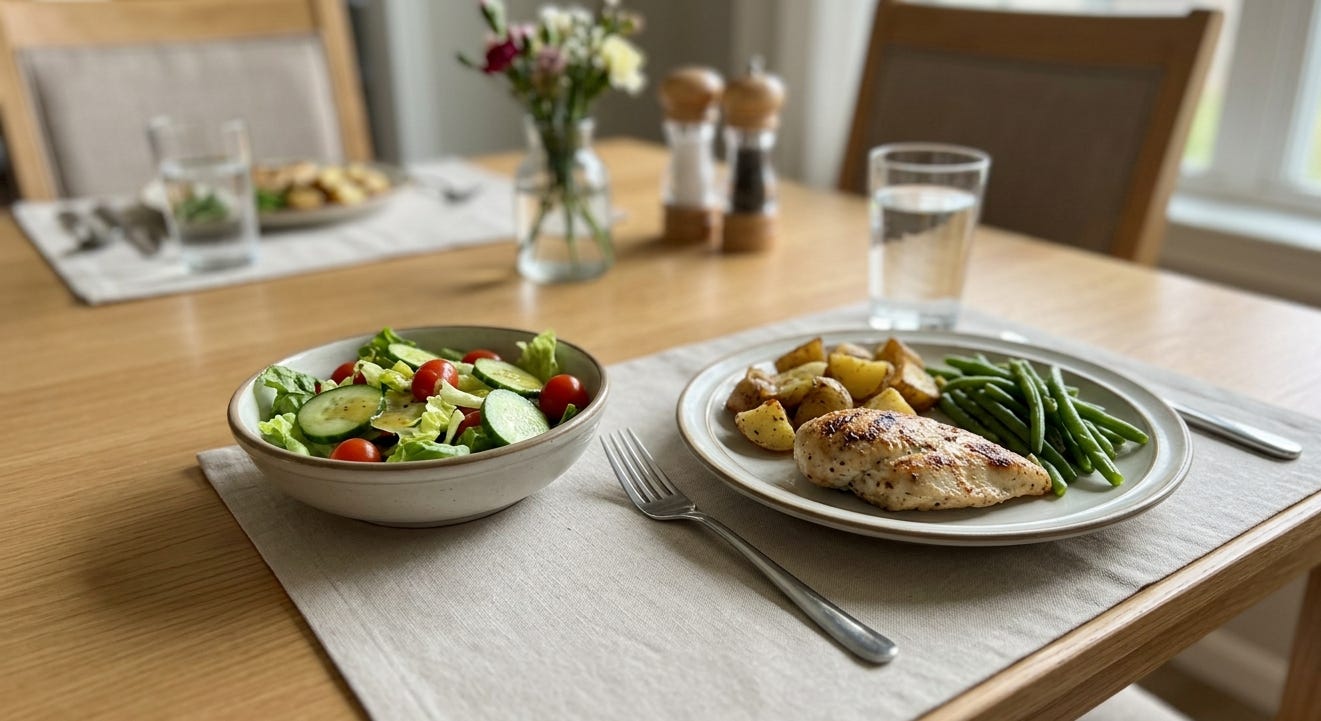
They add a salad before dinner a few nights a week — dressed with a simple olive oil vinaigrette instead of Ranch dressing. (Mediterranean + Volumetric: fat quality and pre-meal volume)
They already like beans. Learning that beans is a potassium-rich, fiber-dense, and metabolically beneficial food, they make them more often and replace one or two red meat portions per week. (Mediterranean + DASH: plant foods, high potassium intake, reduced saturated fat)
They start reading sodium content on nutrition labels — to identify items in their routine shopping list with most of the sodium load, and choosing a lower-sodium alternative when available. (DASH: sodium awareness without obsessive tracking)
They like fruit. They buy more of the varieties they already enjoy and keep them visible. Fruit becomes a more common desert replacing a few portions of ice cream per week. (Volumetric + Mediterranean + DASH: higher fruit intake)
They simply applied five principles to food they already knew and liked. Each change fits their existing life because it was built around it. None of the changes required eliminating anything they enjoy.
Deprivation is one of the primary drivers of dietary abandonment. A strategy that reduces ice cream by making fruit more present and convenient is behaviorally more durable than elimination.
A Point Worth Noting
Ultra-processed foods, products formulated from industrial ingredients rather than whole foods, are consistently associated with higher intakes of saturated fat, added sugar, and sodium, alongside lower intakes of fiber and micronutrients (PMC12734455, 2025). The 2025–2030 US Dietary Guidelines, and the AHA in January 2026, explicitly emphasize limiting consumption of highly processed foods, added sugars, refined grains, and saturated fats (AHA Newsroom, January 2026).
Reducing ultra-processed food consumption addresses all three of the dietary targets that Mediterranean, DASH, and Volumetric eating approach from different angles — simultaneously. It is the single most accessible starting point for most people precisely because of that overlap.
A Single Change at a Time
Look at the principles covered in this piece, fat quality, potassium over sodium, higher fruit and vegetable intake, pre-meal volume, and identify one change that fits your life today. Something small enough that you can adopt with minimal inconvenience. If it holds add one more next month. That is twelve meaningful dietary changes in a year. That is not a diet, is a different relationship with food, built using the food you already know.
Multiple small and sustainable healthy changes in your diet will be more beneficial than abruptly adopting a new dietary system you are unlikely to sustain long term. Go ahead, start today.
The diets covered in this piece are not prescriptions. They are maps. You do not need to follow any of them completely. You need to understand what makes each one work, take what fits your life and make it work within your existing food preferences.
Found this article useful? Share your thoughts — Join the conversation below.
Educational content on The Metabolic Archives is free, because medical information should be accessible to everyone. If you find value in it and want to support the work, a paid subscription is available and genuinely appreciated. Visit the About Page for additional information.
Disclaimer: The information provided in The Metabolic Archives is for educational and informational purposes only, and is not intended as medical advice, diagnosis, or treatment, and does not constitute a doctor-patient relationship. Do not adopt any recommendation discussed in any article or guides published here, make changes or abandon any prescribed medical treatment without prior consultation with your physician. Always seek the advice of your physician or other qualified health provider for any questions regarding your medical condition and recommended treatment options.
By reading this post, you acknowledge that you have read and agree to the Terms of Service of The Metabolic Archives, which govern all use of this content including restrictions on reproduction.
© 2026 The Metabolic Archives. All rights reserved.


