
Lifestyle Modification: The Most Powerful Treatment You Were Never Taught
Part Three: Spot Ultra-Processed Food, What to Look for Before It Goes in Your Cart

Part Two made the case against ultra-processed food. The logical question: how do you actually identify one when you are standing in the supermarket aisle? The answer is already printed on every package.
This piece teaches you to use the right part of the label, recognize the ingredients that disqualify a product immediately, understand what each one does to your metabolism in plain language, and apply a simple three-question framework before anything goes in your cart. It also covers artificial sweeteners: what the current evidence shows about their metabolic consequences so you can make informed choices.
The Right Part of the Label
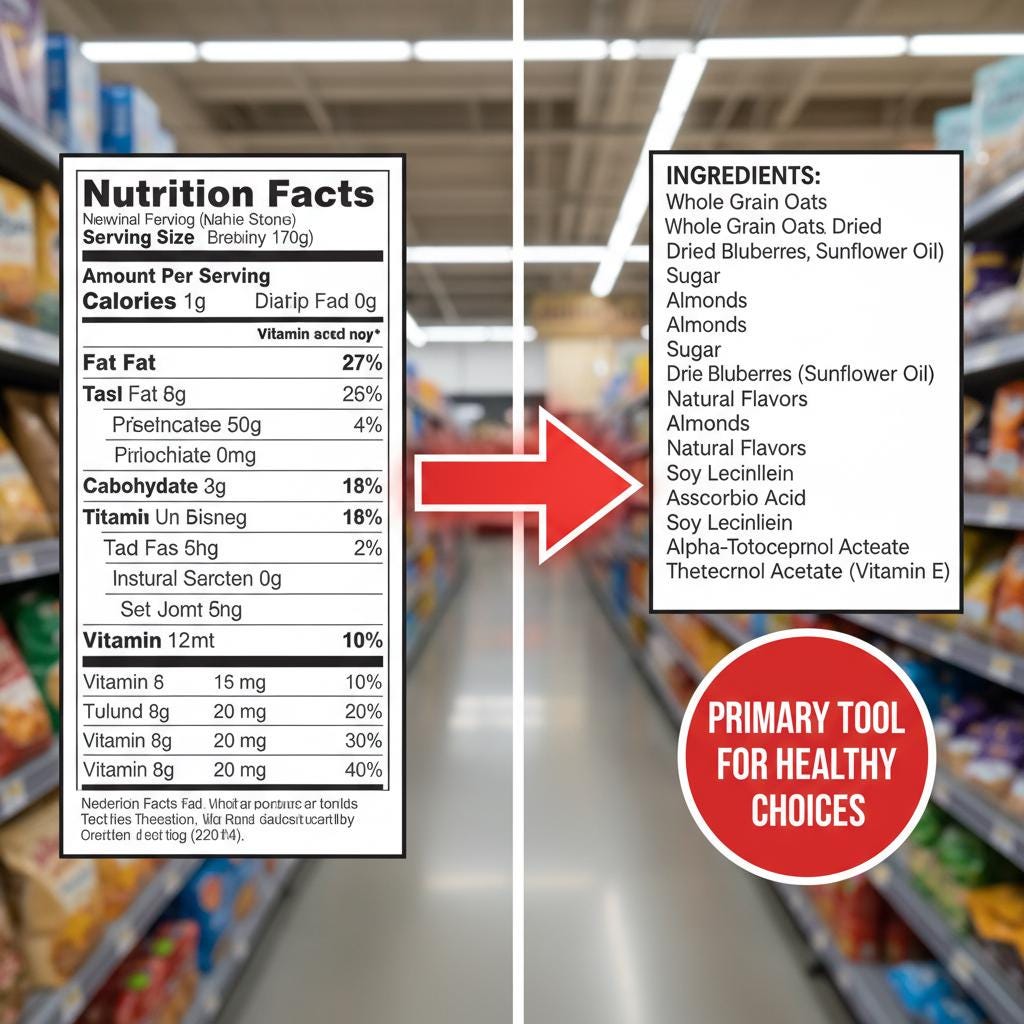
Ingredients are listed by weight in descending order, that is the information you need. The nutrition facts panel still has four numbers worth checking, but the ingredient list is the primary tool.
A large prospective cohort study of 108,643 adults linked specific additive combinations to significantly higher incidence of type 2 diabetes (Lancet Series on Ultra-Processed Foods, Touvier M et al., November 2025). A separate 2025 laboratory study found that mixtures of additives caused toxic effects in human colon, liver, kidney, and neuron cell models that were not observed when the same substances were tested individually.
The Worst Offenders: What to Look for and Why It Matters
Industrial Sweeteners
High fructose corn syrup and its aliases: high fructose corn syrup (HFCS) bypasses the regulatory steps that normally govern glucose metabolism and is processed almost entirely in the liver, where it drives de novo lipogenesis, elevates triglycerides, and contributes to insulin resistance through a pathway that glucose does not share.
On ingredient lists, HFCS may appear as: corn syrup, corn syrup solids, glucose-fructose syrup, isoglucose, or high fructose maize syrup. If any of these aliases appears in the first five ingredients, the product is built on cheap industrial sweetener.
The sugar fragmentation problem: sugar has more than sixty names on ingredient lists. Manufacturers distribute it across multiple entries to prevent any single form from appearing prominently enough to alarm a scanning reader. Dextrose, maltose, maltodextrin, fruit juice concentrate, cane sugar, brown rice syrup, and agave nectar are all sugar by other names.
The one place the nutrition facts panel is genuinely useful is the added sugars line, which aggregates every form of added caloric sweetener into a single gram count, regardless of how many names they appear under. The World Health Organization (WHO) recommends staying below 50 grams of added sugar per day on a 2,000-calorie diet. A single serving of many breakfast cereals, flavored yogurts, or condiments can consume a substantial fraction of that budget.
Industrial Fats
Partially hydrogenated oils: partially hydrogenated oils are the source of artificial trans fats, and they are a disqualifying finding regardless of what the nutrition facts panel claims. Under current US labeling rules, a product with less than 0.5 grams of trans fat per serving can legally declare zero grams on the panel. A product consumed in two or three servings, as many packaged snacks are, can deliver meaningful trans fat exposure under a zero trans fat claim.
Fully hydrogenated oils and interesterified fats: these are the industrial replacements developed after the 2015 FDA determination that partially hydrogenated oils were no longer generally recognized as safe. They are not technically trans fats by regulatory definition, but they are present for the same industrial purpose: extending shelf life and modifying texture in ways that real food fats cannot match as cheaply. The long-term human metabolic evidence on these substitutes is limited.
Seed oils in the first five ingredients: soybean oil, corn oil, cottonseed oil, and sunflower oil appearing in the first five ingredients is a clear marker of industrial manufacturing independent of the omega-6 to omega-3 ratios.
Emulsifiers: The Most Important New Evidence
Carboxymethylcellulose (CMC) and polysorbate 80 (P80) have the strongest documented harm evidence. They thin the intestinal mucus layer that protects epithelial cells, increase gut permeability, elevate lipopolysaccharide (LPS) translocation into the bloodstream, and activate NF-kB inflammatory pathways with upregulation of TNF-alpha and interleukin-6 (IL-6). These are the mechanisms that drive chronic low-grade inflammation and propagate insulin resistance.
Chassaing B et al. demonstrated direct impact of CMC and P80 on human gut microbiota (Microbiome, 2021). A 2024 Communications Biology study confirmed that CMC and P80 induce intestinal inflammation and metabolic syndrome markers through gut permeability elevation and LPS translocation. The most recent and highest-quality human data comes from a 2025 placebo-controlled randomized controlled trial (RCT) of 60 healthy participants published in Clinical Gastroenterology and Hepatology: CMC consumption produced reduced short-chain fatty acid (SCFA) concentrations, and carrageenan produced significantly increased transcellular intestinal permeability compared to placebo.
On ingredient lists, emulsifiers appear as: carboxymethylcellulose, cellulose gum, polysorbate 80, carrageenan, mono and diglycerides, soy lecithin, xanthan gum, and guar gum.

Artificial Colors and Preservatives
Artificial colors: Red 40, Yellow 5, Yellow 6, Blue 1, and Blue 2 are petroleum-derived dyes added to make industrially manufactured products visually appealing. Their presence on an ingredient list is an unambiguous marker of industrial manufacturing. The regulatory landscape is shifting: in 2025, the FDA announced plans to phase out some petroleum-derived dyes from the US food supply, and California signed a law in 2025 legally defining UPF and phasing out the most harmful additives from public school meals.
Sodium benzoate and potassium benzoate: when combined with ascorbic acid in the same product, they can form benzene under certain conditions. Ascorbic acid used alone as a preservative is safe: it is vitamin C. The issue is specific to its combination with benzoate preservatives.
Butylated hydroxyanisole (BHA) and butylated hydroxytoluene (BHT): are petroleum-derived antioxidant preservatives added to extend shelf life. They provide no nutritional benefit to the consumer. Their safety profiles remain contested in the scientific literature. Their presence on a label tells you the product required industrial chemistry to remain stable on a shelf.
Flavor Manipulation Ingredients
Natural flavors: covers a wide range of industrial flavor extracts derived from natural sources and processed through methods that bear little resemblance to home cooking. When natural flavors appear in the first five ingredients, the product’s flavor character is being engineered rather than delivered by the actual food ingredients.
Monosodium glutamate (MSG): the sodium salt of glutamic acid, an amino acid naturally abundant in fermented foods, aged cheeses, and many vegetables. In UPF, it functions as a palatability amplifier designed to make a product taste better.
The First Five Rule
Ingredients are listed by weight in descending order, the first five ingredients are the main ones. If any of the worst offenders described above appear in the first five positions, look for an alternate product.
Real food does not need a paragraph to explain itself. A product with twenty-two ingredients, half of them unpronounceable, is very likely not good for your metabolic health.
What to Actually Use on the Nutrition Facts Panel
Added sugars: aggregates every form of added caloric sweetener, including HFCS, corn syrup, dextrose, maltose, fruit juice concentrates, and all other forms, into a single gram count. The WHO recommendation is below 50 grams per day on a 2,000-calorie diet. Check this number against the serving size actually consumed, not the labeled serving.
Dietary fiber: a grain-based product delivering less than 1 gram of fiber per serving has been heavily refined. More than 3 grams represents a meaningful contribution.
Sodium: check against the potassium amount further down on the label. Ideally potassium should be higher or at least roughly equal to the sodium amount.
Serving size: manufacturers define serving sizes to produce numbers that look favorable. Every number on the nutrition facts panel multiplies by actual consumption. The calorie count that looked reasonable was calculated for a portion nobody eats.
If you enjoy evidence-based medical information, subscribe to receive these articles delivered to your mailbox every week.
Artificial Sweeteners: What They Are, Where They Hide, and What the Evidence Shows
Sucralose (Splenda)
Sucralose is the most widely used sweetener in commercially available diet products and carries the most concerning evidence profile of the sweeteners covered here.
A 2025 triple-blind RCT by Romo-Romo A et al., published in Clinical Nutrition ESPEN, found that 30 days of sucralose consumption at just 30% of the acceptable daily intake (ADI) produced a 20.3% reduction in insulin sensitivity in healthy lean adults, accompanied by reduced microbial diversity, shifts in bacterial populations, and decreased butyrate. A separate 10-week open-label RCT found altered gut bacterial abundance and associated changes in glucose and insulin levels on tolerance testing at 48mg daily sucralose (Mendez-Garcia LA et al., Microorganisms, 2022). The landmark Suez J et al. 2022 RCT of 120 healthy adults published in Cell found that sucralose significantly impaired glycemic responses through microbiome-mediated mechanisms confirmed in mouse transfer experiments (Cell, 2022;185(18):3307-3328).
A 2025 brain imaging RCT from the University of Southern California found that sucralose increased hunger sensation by approximately 17% and increased connectivity in brain regions controlling motivation, leading the researchers to conclude that sucralose interferes with normal appetite regulation in ways that could adversely affect weight control (Page KA et al., Nature Metabolism, 2025).
The appetite disruption evidence across all non-caloric sweeteners remains heterogeneous in the broader human literature. For sucralose specifically, multiple independent RCTs are consistent in direction across microbiome disruption, insulin sensitivity reduction, and appetite dysregulation.
Saccharin (Sweet’N Low)
A large case-control study of 3,010 bladder cancer patients and 5,783 controls found no association with saccharin use. Saccharin was removed from the US National Toxicology Program’s (NTP) list of potential carcinogens in 2001. A 2024 meta-analysis in Minerva Surgery concluded the carcinogenic risk of saccharin is not proven in humans (Balint IB et al., Minerva Surg, 2024;79(1):92-99). The European Food Safety Authority’s (EFSA) 2024 reassessment raised the ADI and concluded the cancer risk in humans is low.
Saccharin’s legitimate metabolic concern in this series is gut microbiome disruption. The Suez et al. 2022 Cell RCT found saccharin significantly impaired glycemic responses through microbiome-mediated mechanisms, comparable in effect to sucralose.
Aspartame (NutraSweet, Equal)
Among the most extensively studied sweeteners, it has the least concerning acute metabolic profile in RCT data. The Suez et al. 2022 Cell RCT found aspartame produced less pronounced microbiome and glycemic effects than saccharin or sucralose.
The 2023 International Agency for Research on Cancer (IARC) Group 2B “possibly carcinogenic” classification reflects limited human evidence and has not changed the safety positions of the FDA or EFSA. EFSA’s comprehensive risk assessment concluded aspartame does not pose a cancer risk at current intake levels.
One critical warning for Phenylketonurics: CONTAINS PHENYLALANINE. Phenylketonuria (PKU) is a rare genetic disorder in which the body cannot metabolize phenylalanine.
Acesulfame-K (Ace-K, Sweet One, Sunett)
It appears in combination with aspartame or sucralose in the majority of products where it is present, used to enhance sweetness while reducing aftertaste. It appears wherever aspartame or sucralose appear, often without consumer awareness that a second sweetener is present.
Acesulfame-K is understudied as an isolated ingredient. Its effects at typical human consumption levels are less well characterized than the other sweeteners on this list, which is itself important given how widely it is consumed. Its co-use with sucralose in particular places it in the same products as the sweetener with the most concerning evidence profile.
Stevia (Truvia, PureVia)
It currently carries the most benign metabolic profile among commonly used sweeteners in the available evidence. The Suez et al. 2022 Cell RCT found stevia produced less pronounced microbiome and glycemic effects than saccharin or sucralose. A large multi-cohort study of 47,910 adults reviewed by Harrold JA et al. found stevia was not associated with obesity risk, unlike sucralose, saccharin, and aspartame, which showed positive associations (PMC, 2024).
The evidence base for stevia is smaller than for older sweeteners. Its benign profile is supported by available data, not established by the same volume of research.
Monk Fruit (Luo Han Guo, Monk Fruit in the Raw)
Monk fruit extract is increasingly present in premium and health-positioned products. The evidence base is limited compared to any of the above, but no significant adverse metabolic findings have emerged to date. It is currently considered alongside stevia as the least concerning option when a non-caloric sweetener is being used.
The Sweetener Hierarchy: Current Evidence Summary
Based on the available evidence, from most to least metabolically concerning:
Sucralose and saccharin: strongest microbiome disruption evidence and most consistent adverse effects on glycemic responses in RCT data
Aspartame and acesulfame-K: mixed or limited evidence; aspartame less concerning in head-to-head RCT comparisons; acesulfame-K understudied in isolation
Stevia and monk fruit: most benign profiles in currently available evidence
This hierarchy reflects the state of the science as of 2025-2026. The human evidence on appetite disruption across all sweetener types remains heterogeneous, and individual variation appears substantial. For a full discussion of the sweetener evidence and its implications for diet sodas, see the Diet Soda: Zero Calories, Not Zero Consequences article on The Metabolic Archives.
The Three Questions at the Shelf
Before anything goes in the cart, ask these in order.
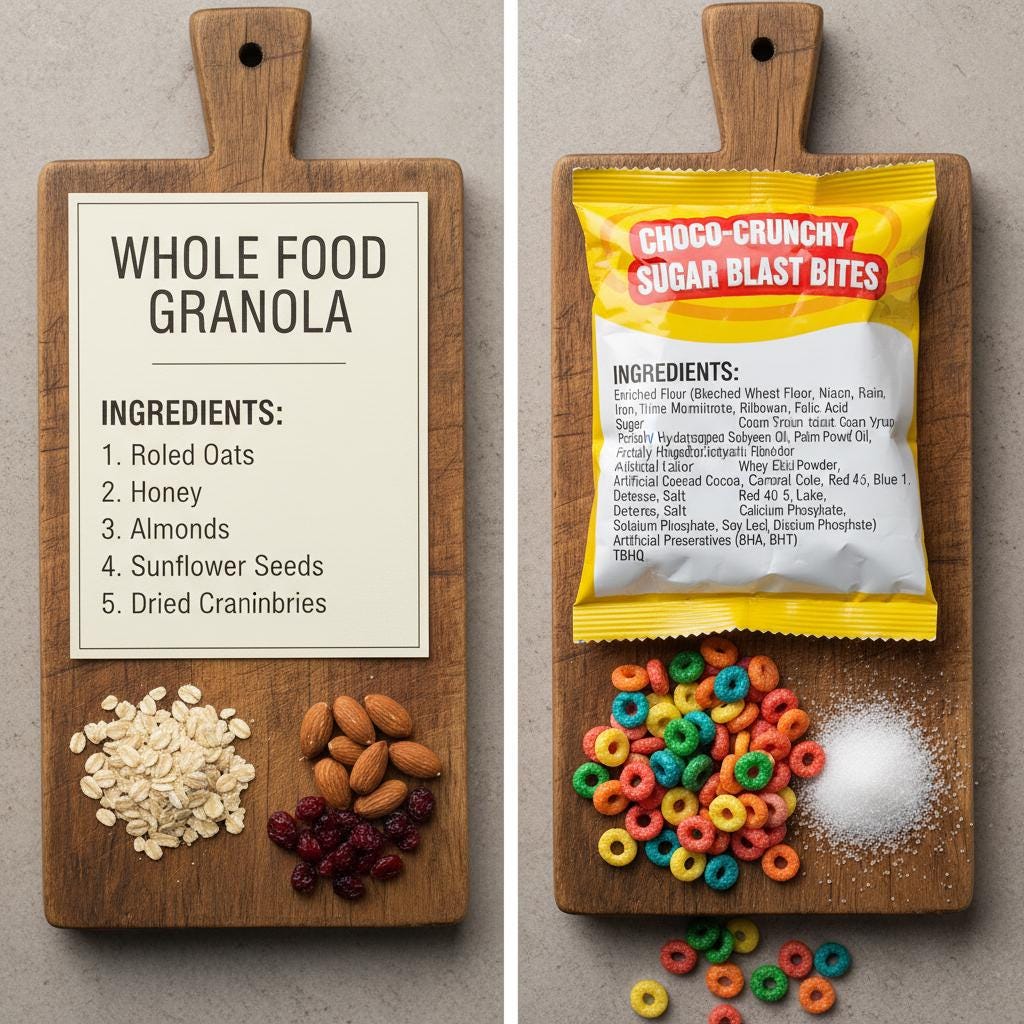
One: Read the ingredient list, not the nutrition label. Are the first five ingredients things you would cook with?
Two: Do any of the worst offenders appear in those first five positions? HFCS or its aliases. Partially hydrogenated oils. Sugar as the first or second ingredient. Industrial emulsifiers. Artificial colors.
Three: How many ingredients are there in total? More than five or six begins to tell a story. A paragraph of ingredients tells the whole story.
For readers who want the complete label-reading methodology, the companion piece Do You Know The One Part of the Food Label That Actually Matters covers the full framework.
The Regulatory Landscape Is Shifting
In 2025, California signed the first law in the United States legally defining ultra-processed food and phasing out the most harmful additives from public school meals. The FDA announced plans in 2025 to phase out certain petroleum-derived artificial dyes from the US food supply. In early 2026, San Francisco filed the first government lawsuit against major UPF producers. The 2025 Lancet Series on Ultra-Processed Foods, authored by 43 international experts, called for stronger regulatory action. Legislators in dozens of US states have introduced or passed bills targeting harmful chemicals in the food supply.
When governments begin to act, the science has typically reached the threshold where the evidence is no longer deniable. You are learning to read a label in a moment when regulators are arriving at the same conclusions.
Found this article useful? Share your thoughts. Join the conversation below.
Educational content on The Metabolic Archives is free, because medical information should be accessible to everyone. If you find value and want to support the work, a paid subscription is available and genuinely appreciated. Visit the About Page for additional information.
The Metabolic Archives is for educational and informational purposes only, and is not intended as medical advice, diagnosis, or treatment, and does not constitute a doctor-patient relationship. Do not adopt any recommendation discussed in any article or guides published here, make changes or abandon any prescribed medical treatment without prior consultation with your physician. Always seek the advice of your physician or other qualified health provider for any questions regarding your medical condition and recommended treatment options.
By reading this post, you acknowledge that you have read and agree to the Terms of Service of The Metabolic Archives, which govern all use of this content including restrictions on reproduction.
© 2026 The Metabolic Archives. All rights reserved.
Whole food. Grown or raised in one’s backyard.